
Table of Contents
HVAC SEO: The Ultimate Guide to Getting More Calls, More Leads & More Local Customers
If you own an HVAC company in the United States, you've probably noticed one thing over the last few years getting new customers has become more competitive than ever. Whether you offer AC repair, furnace installation, heat pump replacement, emergency HVAC services, or commercial HVAC maintenance, your potential customers are searching online before they ever pick up the phone.
The question isn't whether people are looking for HVAC services. They are.
The real question is this:
When someone searches "AC repair near me" or "best HVAC company in Dallas," does your business appear or does your competitor get the call?
Today's homeowners don't flip through phone books or wait for referrals. They open Google, search for a problem, compare the businesses that appear, read reviews, visit websites, and contact the company that gives them the most confidence.
That's where HVAC SEO (Search Engine Optimization) becomes one of the most valuable long-term investments for an HVAC business.
Unlike Google Ads that stop generating leads the moment your budget runs out, SEO helps your website earn organic visibility. A properly optimized HVAC website can consistently attract local customers who are actively searching for your services—without paying for every click.
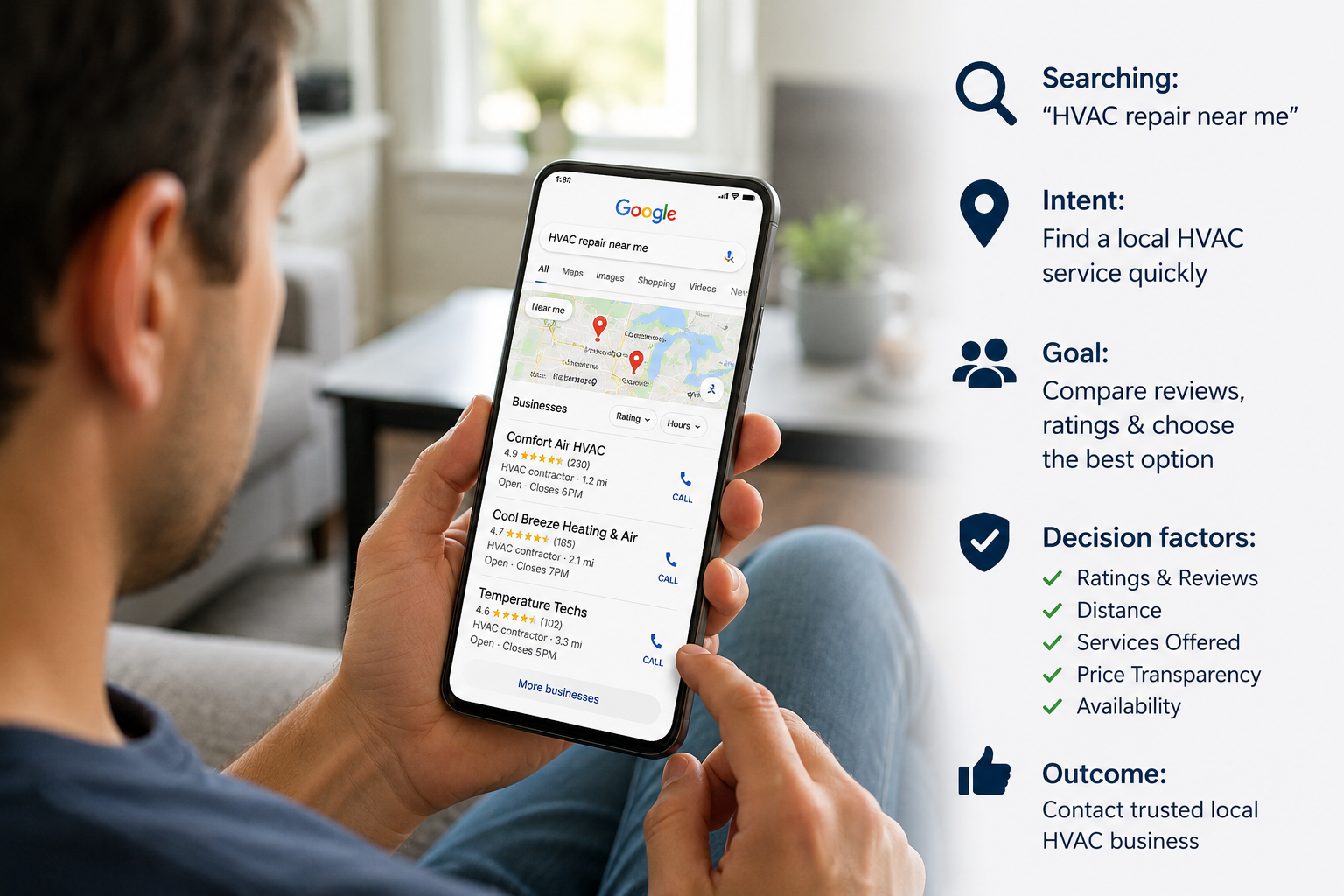
Why HVAC SEO Matters More Than Ever in 2026
The HVAC industry continues to grow across the United States, but so does the competition. Nearly every city now has dozens—or even hundreds—of HVAC contractors competing for the same local customers.
Google has also become smarter.
Simply having a website is no longer enough. Google now evaluates:
- Website quality
- Helpful and trustworthy content
- Local relevance
- Customer reviews
- Business authority
- Page speed
- Mobile experience
- Technical SEO
- Google Business Profile optimization
- Backlinks from trusted websites
Businesses that consistently perform well in these areas earn higher rankings. Those that don't gradually lose visibility, even if they've been operating for decades.
This is why many established HVAC companies are surprised to find newer competitors ranking above them in local search results. The difference usually isn't experience—it's SEO.
What You’ll Learn in This HVAC SEO Guide
This isn't another surface-level article filled with generic marketing advice.
Instead, this guide is designed specifically for HVAC business owners in the United States who want to generate more qualified leads through Google Search.
By the end of this guide, you'll understand how to:
- Rank higher for valuable HVAC keywords in your service areas.
- Improve your Google Business Profile to attract more local customers.
- Build service pages that convert visitors into phone calls.
- Create content that answers customer questions and earns trust.
- Strengthen your website's authority with ethical link-building.
- Measure SEO performance using meaningful business metrics.
- Avoid common mistakes that prevent HVAC companies from ranking.
Whether you manage a single-location HVAC company or operate across multiple cities, the strategies in this guide can help you build sustainable organic growth.
SEO Isn’t About Rankings—It’s About Revenue
Many business owners ask, "How can I rank #1 on Google?"
A better question is:
How can I generate more profitable HVAC jobs from Google?
Higher rankings are valuable only if they lead to real business outcomes:
- More service calls
- More installation requests
- More maintenance agreements
- More emergency repair inquiries
- Higher-quality local leads
- Increased revenue without depending entirely on paid advertising
That is the true purpose of HVAC SEO.
Throughout this guide, we'll focus on strategies that don't just improve rankings—they help your HVAC business attract customers who are ready to book your services.
What is HVAC SEO?
If someone told you SEO is simply "getting your website to rank on Google," they're only telling half the story.
For an HVAC business, SEO (Search Engine Optimization) is the process of making your company the obvious choice whenever homeowners or businesses search for heating and cooling services online. It's about ensuring your website, your Google Business Profile, and your online reputation work together to attract local customers who are actively looking for help—not people casually browsing the internet.
Imagine a homeowner in Houston whose air conditioner stops working in the middle of July. They aren't searching for general information about HVAC systems. They need immediate assistance. Their search might look like:
- AC repair near me
- Emergency HVAC repair Houston
- Air conditioning repair open now
- Best HVAC company in Houston
- Furnace replacement cost
- Heat pump installation near me
Google's job is to recommend the businesses most likely to solve that person's problem. HVAC SEO helps your business become one of those trusted recommendations.
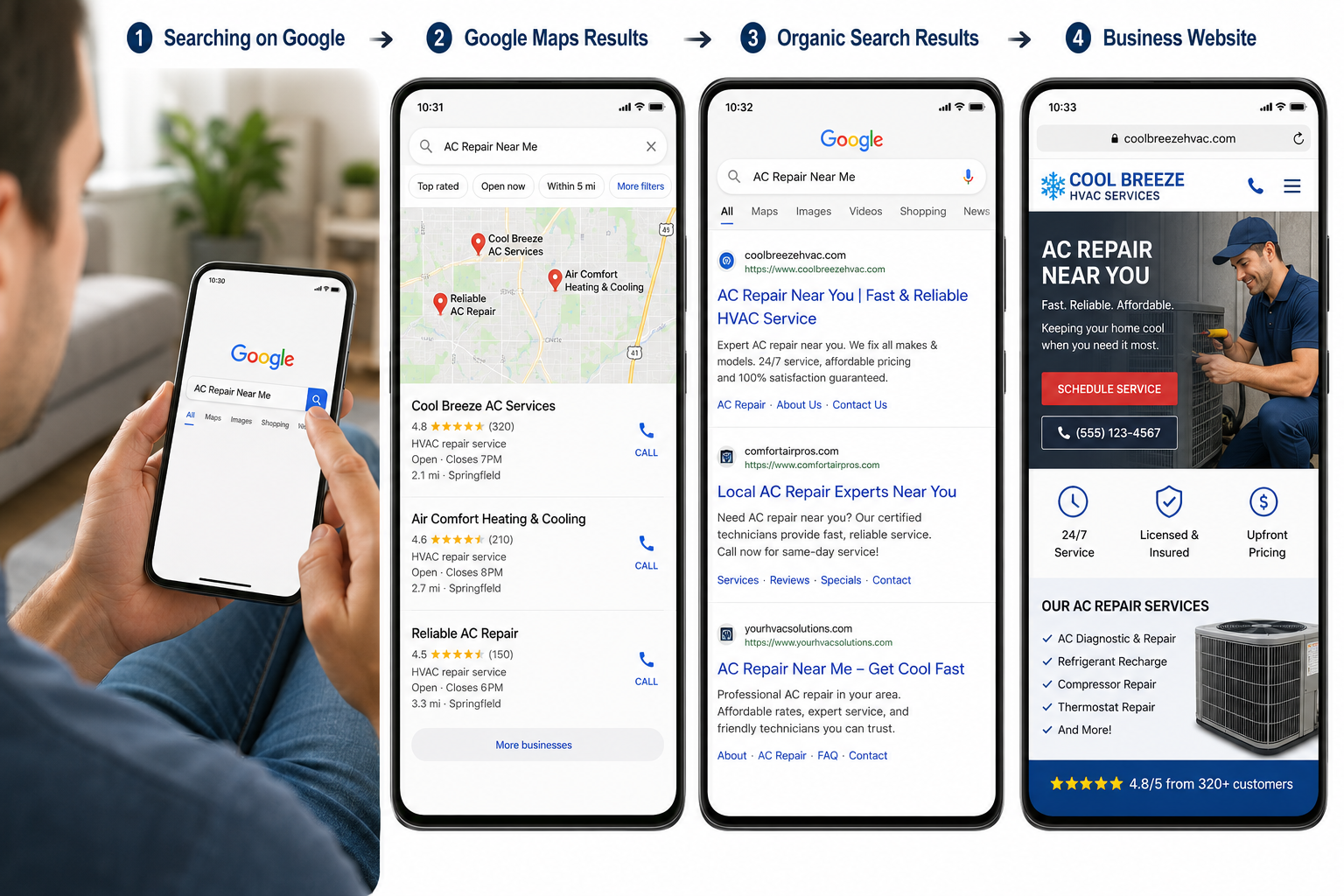
HVAC SEO Is More Than Ranking #1
Many HVAC contractors believe success means ranking first for "HVAC Company."
In reality, successful SEO is about dominating the entire customer journey.
When someone searches online, Google may display:
- Google Business Profile (Map Pack)
- Local Service Ads
- Organic search results
- People Also Ask questions
- Reviews
- Images
- Videos
- FAQs
Every one of these areas is an opportunity to earn a customer's trust before they even visit your website.
Think of SEO as building your digital reputation. The stronger that reputation, the more often Google recommends your business.
How Google Decides Which HVAC Companies Rank
Google uses hundreds of ranking signals, but for local HVAC businesses, several factors consistently influence visibility.
1. Local Relevance
Google wants to show companies that genuinely serve the searcher's location.
If someone searches:
"AC Repair Dallas"
Google will prioritize businesses with strong local signals, including:
- A well-optimized Google Business Profile
- Location-specific service pages
- Consistent business information across online directories
- Customer reviews mentioning Dallas and nearby communities
This is why local SEO forms the foundation of every successful HVAC marketing strategy.
2. Website Quality
Your website should answer visitors' questions quickly and clearly.
Google evaluates factors such as:
- Helpful service descriptions
- Fast loading speed
- Mobile responsiveness
- Easy navigation
- Clear calls to action
- Secure HTTPS connection
- Structured content
A website designed solely to "look nice" often underperforms if it doesn't provide useful information or a seamless user experience.
3. Authority & Trust
Google asks a simple question:
"Can this HVAC company be trusted?"
It looks for signals like:
- High-quality backlinks from reputable websites
- Positive customer reviews
- Detailed service pages
- Expert, original content
- Years of business experience reflected online
- Consistent branding across the web
Trust isn't built overnight. It grows through sustained SEO efforts that demonstrate expertise and reliability.
The HVAC Customer Journey: From Search to Service Call
One of the biggest mistakes HVAC companies make is focusing only on the final search, such as "HVAC contractor near me."
In reality, customers often go through several stages before making a decision.
| Customer Stage | Example Search |
|---|---|
| Problem Awareness | Why is my AC blowing warm air? |
| Research | How much does AC repair cost? |
| Comparison | Best HVAC company in Phoenix |
| Purchase Intent | Emergency AC repair near me |
| Decision | HVAC company reviews |
Businesses that create helpful content for each stage build trust earlier in the buying process. By the time a homeowner is ready to book, your company is already familiar and credible.
Pro Tip: Don't just optimize for "near me" searches. Educational content that answers common HVAC questions can introduce your business to potential customers before they're ready to hire, increasing the likelihood they'll choose you later.
SEO vs. Google Ads: Which Delivers Better Long-Term Value?
Many HVAC business owners ask whether they should invest in SEO or Google Ads.
The answer depends on your goals.
| SEO | Google Ads |
|---|---|
| Builds long-term organic visibility | Provides immediate traffic |
| Continues generating leads over time | Stops when your budget runs out |
| Improves website authority | Doesn't increase organic rankings |
| Often delivers a lower cost per lead over time | Cost per click can rise in competitive markets |
| Strengthens your brand's online presence | Focuses on paid visibility only |
For most HVAC companies, the strongest strategy is to use Google Ads for short-term lead generation while investing in SEO to create a sustainable pipeline of organic inquiries.
Expert Insight
At Jaseir, we've seen HVAC businesses achieve their strongest growth when SEO is treated as a long-term business asset rather than a one-time marketing task. A well-executed strategy compounds over time—each optimized service page, each valuable blog post, each positive review, and each quality backlink contributes to greater visibility and more qualified leads.
Related Reading: See how our SEO approach helped an HVAC business improve its online visibility and lead generation in our HVAC SEO Case Study.
Key Takeaways
- HVAC SEO is about generating qualified local leads, not just improving rankings.
- Google evaluates local relevance, website quality, authority, and user experience.
- Successful HVAC companies optimize every stage of the customer's buying journey.
- Combining Local SEO with valuable content creates long-term business growth.
- Organic SEO becomes more valuable over time, unlike paid advertising that ends when spending stops.
Local HVAC SEO: The Foundation of Every Successful HVAC Marketing Strategy
If there is one area of SEO that every HVAC business owner should prioritize, it is Local SEO.
Why?
Because almost every HVAC customer is looking for a company that serves their immediate area. Someone in Chicago doesn't want an HVAC contractor in Miami. Likewise, a homeowner in Phoenix isn't interested in businesses located two states away.
Google understands this.
That's why local search results dominate HVAC-related searches.
Try searching for any of these terms:
- HVAC company near me
- AC repair near me
- Furnace repair near me
- Emergency HVAC service
- Air conditioning repair Dallas
In most cases, the first thing you'll notice isn't the traditional website results.
Instead, Google displays the Local Map Pack—the section featuring a map, business listings, reviews, phone numbers, and directions.
For many HVAC businesses, this area generates more phone calls than standard organic search results.
If your company isn't appearing there, you're missing out on some of the highest-intent customers.
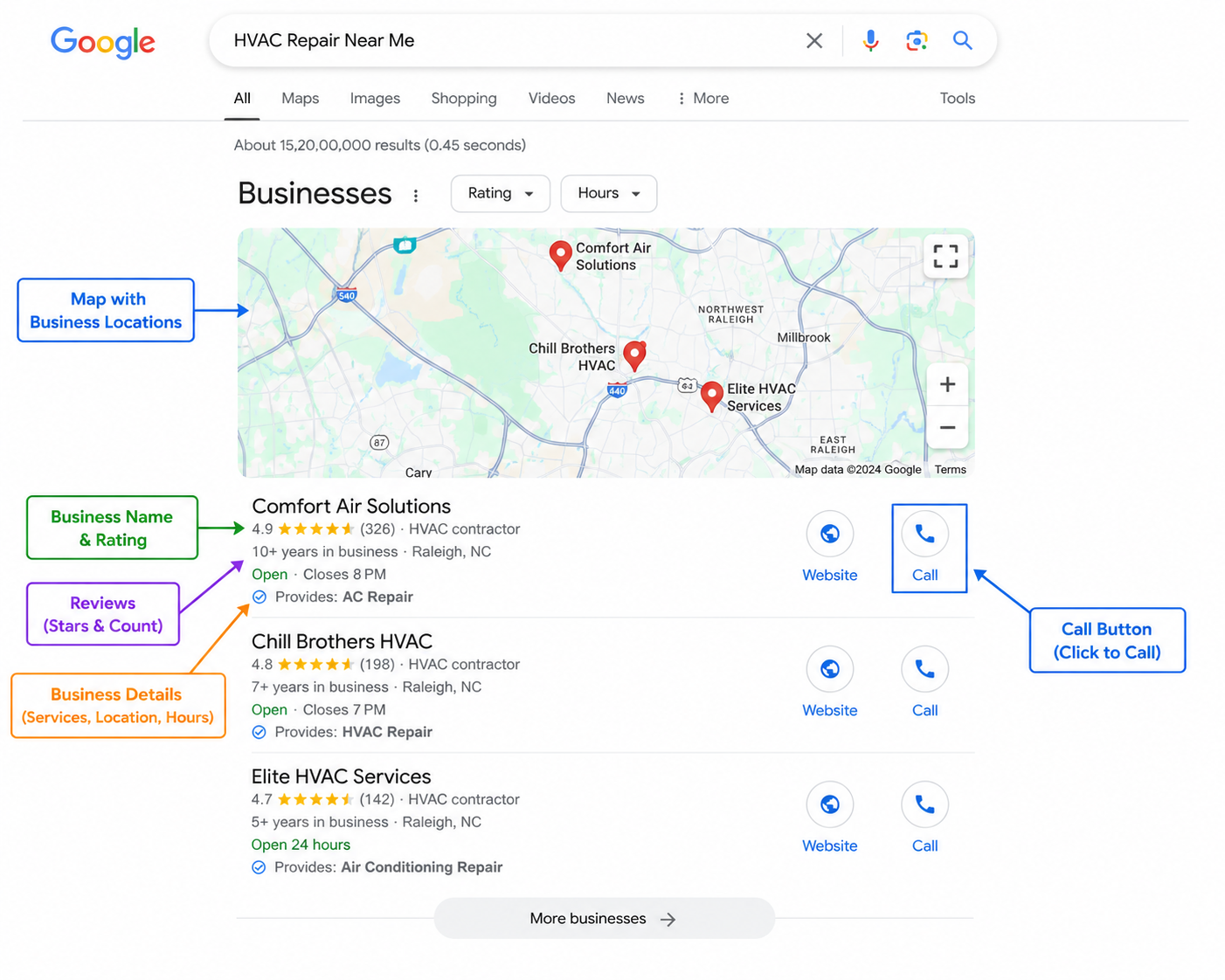
What Is Local HVAC SEO?
Local HVAC SEO is the process of improving your online presence so that Google confidently recommends your business to people searching for HVAC services within your service area.
Unlike traditional SEO, Local SEO isn't focused on ranking nationally.
Instead, it's about becoming the most trusted HVAC company in the cities and neighborhoods you serve.
Whether you operate in:
- Dallas
- Houston
- Austin
- Phoenix
- Denver
- Orlando
...your objective is the same:
Own the local search results where your ideal customers live and work.
Why Local SEO Generates Better Leads
Not every website visitor becomes a customer.
However, people searching locally usually have immediate intent.
Compare these searches:
| Search Query | Search Intent |
|---|---|
| How does an AC work? | Learning |
| HVAC maintenance tips | Research |
| Best HVAC company in Tampa | Comparing companies |
| Emergency AC repair near me | Ready to hire |
| HVAC repair open now | Immediate need |
Notice how intent changes.
The closer someone gets to phrases like:
- near me
- open now
- emergency
- same-day
- 24-hour
- best HVAC company
…the more likely they are to contact a business.
These are the searches your Local SEO strategy should prioritize.
The Three Pillars of Local HVAC SEO
Many business owners assume Local SEO means simply creating a Google Business Profile.
That's only one piece of the puzzle.
A strong Local SEO strategy is built on three interconnected pillars.
1. Google Business Profile Optimization
Your Google Business Profile (formerly Google My Business) is often the first interaction customers have with your company.
A complete profile should include:
- Accurate business name
- Primary HVAC category
- Secondary service categories
- Phone number
- Website
- Business hours
- Emergency availability (if offered)
- Service areas
- Professional photos
- Business description
- Customer reviews
- Frequently asked questions
An incomplete profile sends weak trust signals to Google—and to potential customers.
2. Your Website
Even if your Google Business Profile ranks well, customers will often click through to your website before making a decision.
They want answers to questions like:
- What HVAC services do you offer?
- Which cities do you serve?
- How long have you been in business?
- Are you licensed and insured?
- Can I schedule online?
- Do you offer financing?
- What do customers say about your work?
A well-optimized website reinforces trust and helps convert visitors into leads.
3. Online Reputation
Google wants to recommend businesses with a proven history of customer satisfaction.
That means your online reputation matters.
This includes:
- Google Reviews
- Business directories
- Local citations
- Industry associations
- Better Business Bureau listings
- Customer testimonials
- Third-party review websites
The stronger your reputation across the web, the more confidence Google has in recommending your business.
Expert Tip
Many HVAC companies invest heavily in redesigning their website while neglecting reviews and their Google Business Profile. In reality, Local SEO performs best when your website, reviews, citations, and Google Business Profile work together as a unified system.
Google Business Profile: Your Most Important Local SEO Asset
If your HVAC business serves customers within a specific geographic area, your Google Business Profile may be your most valuable marketing asset.
Why?
Because it can help you appear in:
- Google Maps
- Local Pack
- Mobile searches
- Voice searches
- "Near me" searches
- Navigation apps
Many homeowners never even visit your website.
They simply:
✔ Read reviews
✔ View photos
✔ Tap Call
✔ Request Directions
That means your profile itself can generate leads.
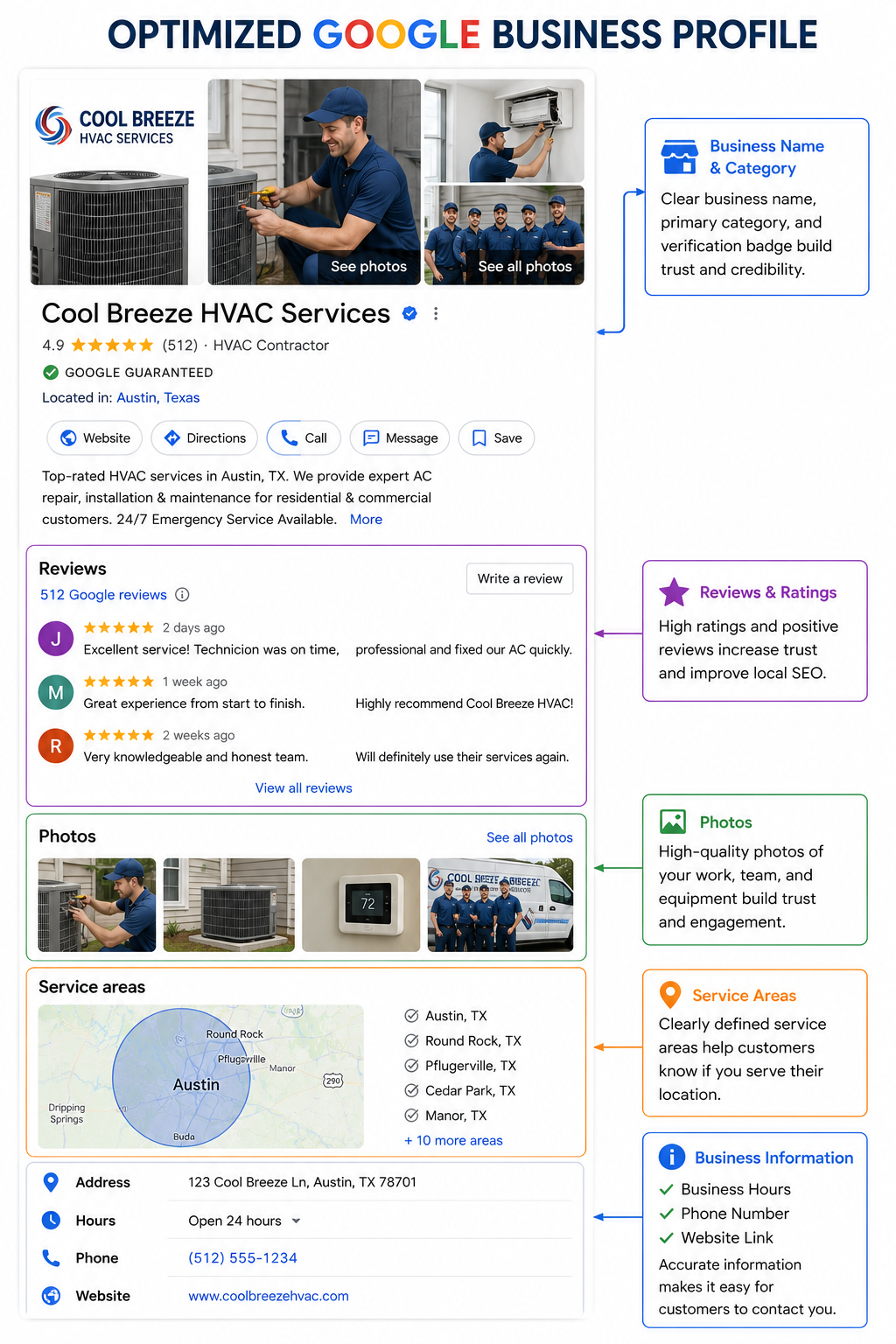
How Google Chooses Local HVAC Rankings
Google has publicly stated that local rankings are primarily influenced by three factors:
Relevance
Does your business match what the customer is searching for?
For example:
Someone searching:
Heat Pump Installation
is more likely to see businesses that clearly mention heat pump installation—not just "HVAC services."
Distance
How close is your business to the searcher?
Although you can't control a user's location, you can strengthen geographic relevance by:
- Creating city-specific service pages
- Clearly listing service areas
- Using localized content
- Earning reviews from customers in different cities
Prominence
Prominence measures how well-known and trusted your business is.
Signals include:
- Review quantity
- Review quality
- Local backlinks
- Brand mentions
- Website authority
- Business citations
- Years in operation
- Overall online presence
Think of prominence as your digital reputation. The stronger it is, the more confidence Google has in displaying your business for competitive local searches.
Local SEO Checklist for HVAC Companies
Before moving on, make sure your business has these essentials in place:
☐ Fully optimized Google Business Profile
☐ Consistent Name, Address, and Phone Number (NAP) across all directories
☐ City-specific HVAC service pages
☐ Positive Google reviews with regular new additions
☐ Fast, mobile-friendly website
☐ Clear service area information
☐ Click-to-call phone numbers
☐ Online contact form
☐ Internal links to your HVAC SEO Service, Local SEO, SEO Services, and Contact pages
Real-World Insight
At Jaseir, one of the first steps in every HVAC SEO campaign is evaluating a company's local search presence—not just its website. We've found that improving Google Business Profile optimization, local relevance, and service-area content often delivers measurable gains before more advanced SEO tactics are introduced. You can see this approach in action through our HVAC SEO Case Study.
HVAC Keyword Research: The Blueprint for Attracting High-Quality Leads
One of the biggest misconceptions about SEO is that it's all about ranking for the keyword "HVAC SEO" or "HVAC company."
It isn't.
The real goal is to rank for the searches your future customers make at every stage of their buying journey.
A homeowner with no air conditioning in the middle of summer searches very differently than someone planning to replace an aging HVAC system next month.
If your website only targets a handful of broad keywords, you're leaving thousands of valuable searches—and potential customers—on the table.
That's why keyword research is the foundation of every successful HVAC SEO campaign.
At Jaseir, we don't start with content. We start by understanding how your customers search, what they need, and when they're ready to hire. Only then do we build pages that match those search intents.
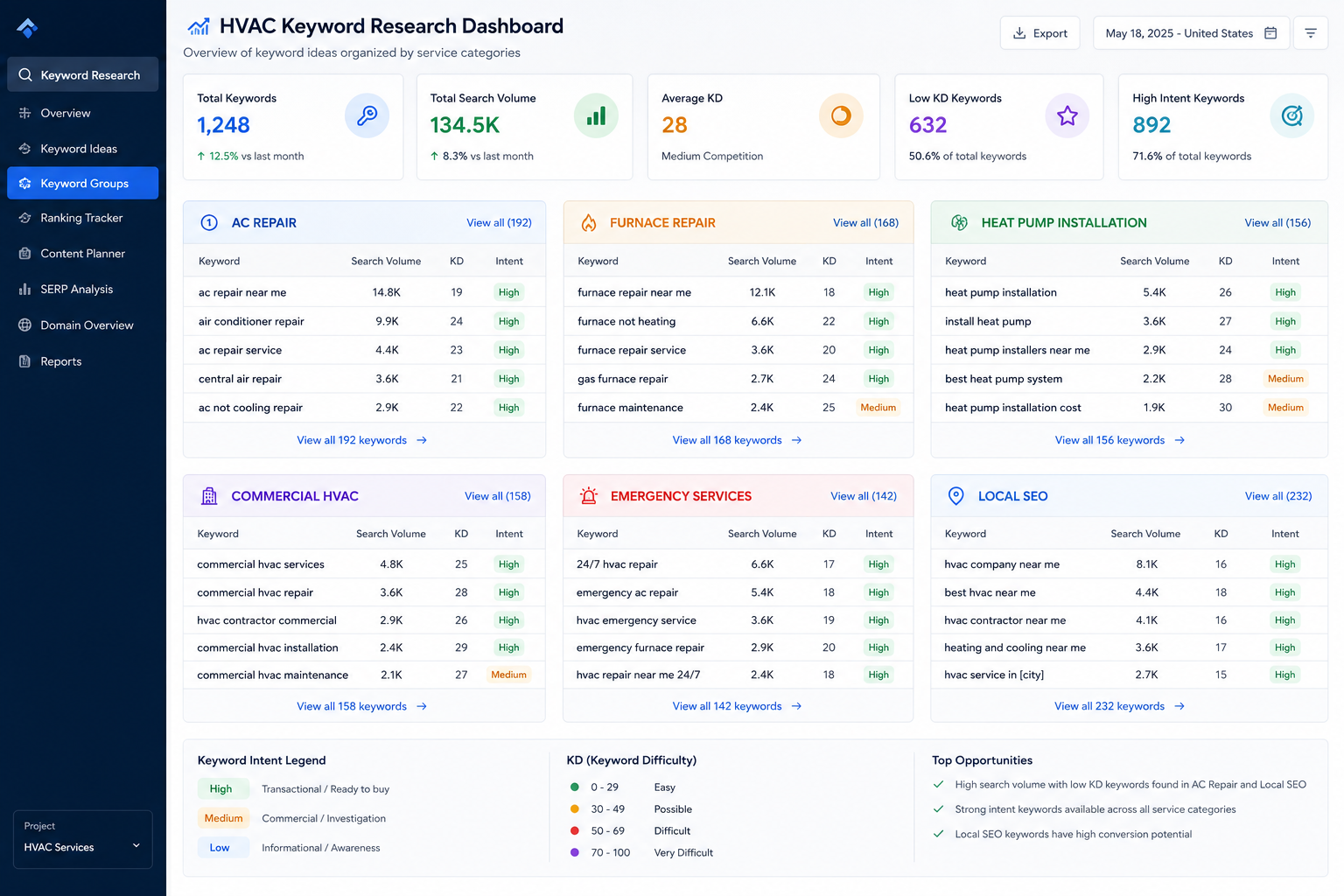
What Is HVAC Keyword Research?
HVAC keyword research is the process of identifying the exact phrases homeowners and businesses use when searching for heating and cooling services online.
These keywords help Google understand what your website is about and determine which pages should appear for different searches.
For example, someone may search:
- AC repair near me
- Air conditioner not cooling
- Furnace installation company
- HVAC maintenance plans
- Commercial HVAC contractor
- Emergency heating repair
- Heat pump replacement cost
- Ductless mini split installation
Each search has a different purpose, and your website should provide the best answer for each one.
The more closely your content matches user intent, the better your chances of ranking—and converting visitors into customers.
Why Keyword Intent Matters More Than Search Volume
Many business owners focus only on keywords with the highest search volume.
That's a mistake.
A keyword with 300 monthly searches can generate more revenue than one with 10,000 searches if it reflects strong buying intent.
Consider these examples:
| Keyword | Search Intent | Likelihood to Become a Customer |
|---|---|---|
| What is an HVAC system? | Informational | Low |
| How often should AC be serviced? | Educational | Medium |
| Best HVAC company in Dallas | Commercial Investigation | High |
| Emergency AC repair near me | Transactional | Very High |
| HVAC installation quote | Transactional | Very High |
Notice how the intent becomes stronger as the customer gets closer to making a decision.
This is why a successful HVAC SEO strategy targets every stage of the customer journey, while placing special emphasis on high-intent searches.
The Four Types of HVAC Keywords Every Website Needs
A high-performing HVAC website doesn't rely on one type of keyword. It uses a balanced strategy that captures traffic across multiple search intents.
1. Service Keywords
These are your most important money-making keywords because they describe the services customers are actively seeking.
Examples include:
- AC repair
- Air conditioner installation
- Furnace repair
- Furnace replacement
- Heat pump installation
- Heat pump repair
- HVAC maintenance
- Indoor air quality services
- Duct cleaning
- Commercial HVAC services
- Emergency HVAC repair
Each core service should have its own dedicated page. Avoid combining unrelated services into a single page, as this makes it harder for Google to understand your expertise.
2. Local Keywords
HVAC is a local business, so geography matters.
Instead of optimizing only for:
AC Repair
Create pages targeting:
- AC Repair Dallas
- Furnace Repair Phoenix
- HVAC Company Tampa
- Heat Pump Installation Charlotte
- Emergency HVAC Houston
Google wants to connect users with businesses that serve their specific location. Dedicated city and service-area pages help reinforce that relevance.
3. Problem-Based Keywords
Not every customer knows which service they need. Many search based on the problem they're experiencing.
Examples include:
- AC blowing warm air
- Furnace won't turn on
- HVAC making loud noises
- Uneven cooling in house
- Heat pump frozen outside
- High energy bills after AC installation
- Thermostat not working
Creating helpful content around these issues positions your business as a trusted resource and introduces potential customers to your services before they start comparing contractors.
4. Buying Intent Keywords
These searches come from users who are close to hiring.
Examples:
- Best HVAC company near me
- Top-rated AC repair company
- Licensed HVAC contractor
- HVAC financing available
- Same-day HVAC repair
- 24-hour HVAC service
- HVAC maintenance plans
- Free HVAC estimate
These keywords should be woven naturally into your service pages, testimonials, FAQs, and calls to action.
Expert Tip
Many HVAC websites compete for broad keywords while overlooking long-tail searches with lower competition and stronger purchase intent. Ranking for dozens of highly specific phrases often generates more qualified leads than chasing a single high-volume keyword.
Build Topic Clusters Instead of Isolated Pages
Modern SEO isn't about creating random blog posts.
Google rewards websites that demonstrate expertise through topical authority.
That means your content should be organized into clusters around a central topic.
For example:
Pillar Page:
The Complete HVAC SEO Guide for 2026
Supporting content might include:
- Local SEO for HVAC Companies
- HVAC Google Business Profile Optimization
- HVAC Website Design Best Practices
- HVAC Link Building Strategies
- HVAC Content Marketing Guide
- Common HVAC SEO Mistakes
- How to Rank in Google's Local Map Pack
- HVAC SEO Case Study
These supporting pages should link back to the main pillar guide and to each other where relevant.
This interconnected structure helps Google understand that your website is an authoritative resource on HVAC SEO—not just a collection of unrelated articles.
Keyword Research Isn’t a One-Time Task
Search behavior evolves over time.
New technologies, seasonal trends, changes in homeowner priorities, and Google's algorithm updates all influence how people search.
Successful HVAC businesses review their keyword strategy regularly to identify:
- New service opportunities
- Emerging search trends
- Seasonal demand
- Competitor movements
- Underperforming pages
- High-converting keyword opportunities
SEO is an ongoing process of refinement—not a project you complete once and forget.
Real-World Insight
When we begin an HVAC SEO campaign at Jaseir, keyword research extends far beyond identifying popular search terms. We analyze search intent, local competition, existing rankings, and business priorities to create a strategy that attracts leads—not just traffic. This approach ensures that every optimized page contributes to measurable business growth. You can see the results in our HVAC SEO Case Study (Internal Link: /case-studies/hvac-seo-services/).
Key Takeaways
- Effective keyword research focuses on user intent, not just search volume.
- Every core HVAC service deserves its own optimized page.
- Combine service keywords, local keywords, problem-based queries, and buying-intent phrases.
- Build topic clusters to establish authority and improve internal linking.
- Regularly review and expand your keyword strategy to stay ahead of competitors.
On-Page HVAC SEO: How to Turn Website Visitors into Paying Customers
Driving traffic to your website is only half the battle.
What happens after someone lands on your page determines whether they become a customer—or leave and call your competitor.
Many HVAC websites have decent rankings but still struggle to generate leads because their pages are built for search engines instead of people.
On the other hand, some websites look visually impressive but lack the SEO structure Google needs to understand and rank their content.
Successful HVAC websites do both exceptionally well.
They satisfy Google's ranking requirements while giving homeowners confidence to schedule a service call.
This is the purpose of On-Page SEO.
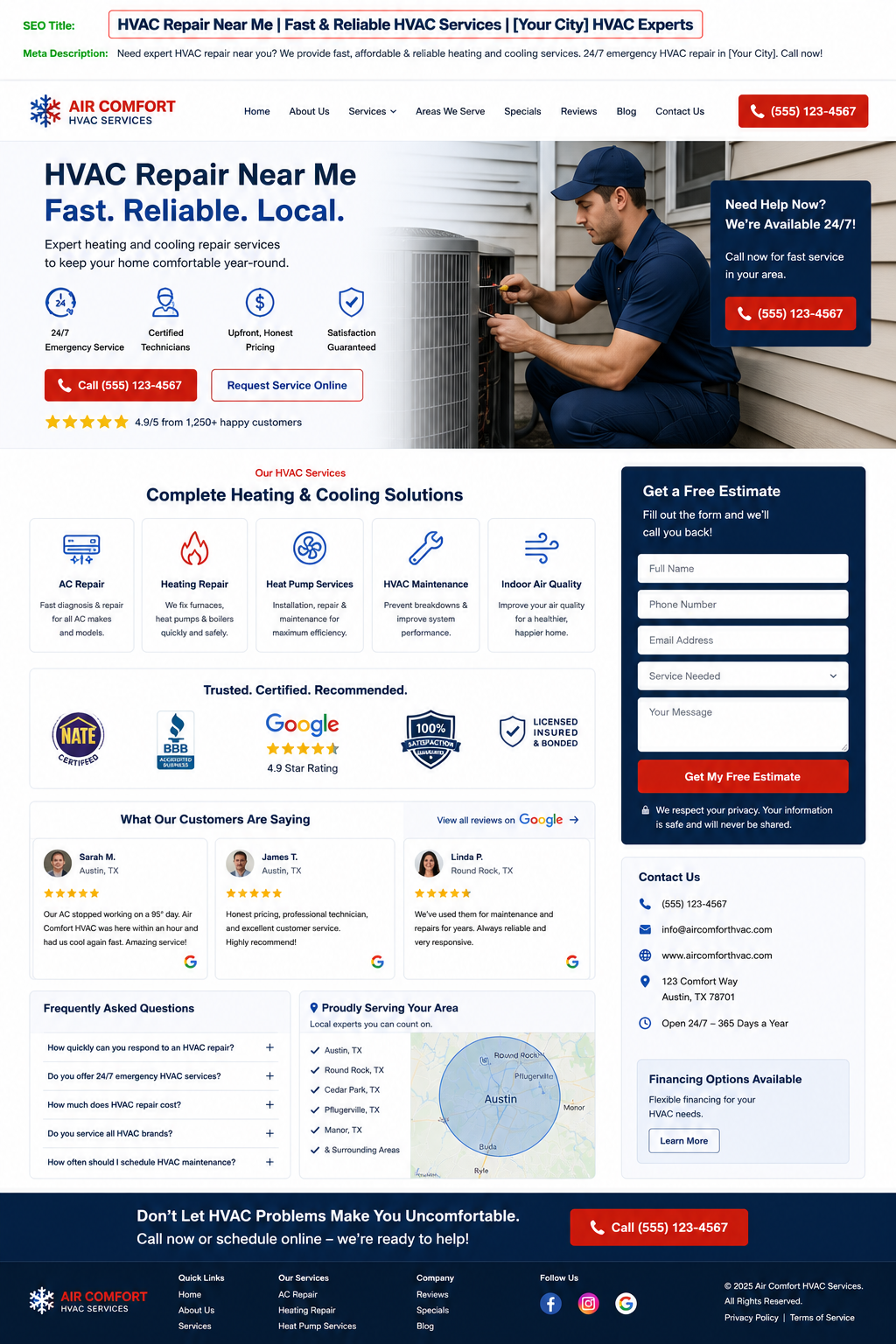
What Is On-Page SEO?
On-page SEO refers to everything you optimize on your website to improve rankings and user experience.
This includes:
- Page titles
- Meta descriptions
- URLs
- Headings
- Content quality
- Images
- Internal links
- Calls-to-action
- User experience
- Mobile responsiveness
- Page speed
- Schema markup
Every page on your website should have a clear purpose and answer one specific search intent.
For example:
A page targeting "AC Repair Dallas" should focus entirely on that service—not include unrelated discussions about furnace installation or indoor air quality.
The more focused a page is, the easier it becomes for Google to understand its purpose.
Every HVAC Service Deserves Its Own Page
One of the most common SEO mistakes is placing every service on a single page.
For example:
"Our company provides AC repair, furnace repair, duct cleaning, maintenance, installations, commercial HVAC, indoor air quality, and heat pumps."
While this may seem convenient, it weakens your SEO.
Instead, create dedicated pages for each major service.
For example:
- AC Repair
- AC Installation
- Furnace Repair
- Furnace Installation
- Heat Pump Services
- Indoor Air Quality
- Ductless Mini Split Systems
- Commercial HVAC
- HVAC Maintenance Plans
- Emergency HVAC Repair
Each page can target its own keywords, answer customer questions, and build topical authority.
Google rewards websites that provide depth—not just broad overviews.
Write for Customers First, Google Second
Years ago, SEO meant repeating the same keyword over and over.
For example:
"Our HVAC company offers HVAC services because our HVAC company is the best HVAC company."
That approach no longer works.
Modern SEO rewards content that is:
- Helpful
- Natural
- Comprehensive
- Easy to understand
- Written by knowledgeable professionals
Instead of forcing keywords into every sentence, write the way you would explain your services to a homeowner during an estimate.
Google is sophisticated enough to understand related terms such as:
- Air conditioning repair
- Cooling system repair
- HVAC contractor
- Heating services
- Climate control systems
- Home comfort solutions
Using natural language improves both readability and rankings.
Structure Every Service Page for Maximum Conversions
An optimized HVAC service page should answer questions before the customer asks them.
A strong structure might include:
Hero Section
Clearly state:
- What service you provide
- Where you provide it
- A compelling value proposition
- Prominent phone number
- "Schedule Service" button
Example:
Professional AC Repair Services in Dallas, TX
Fast, reliable air conditioning repairs from licensed HVAC technicians. Same-day appointments available.
Explain the Problem
Describe the issues customers commonly experience.
For example:
- Warm air from vents
- Strange noises
- High energy bills
- Refrigerant leaks
- Frozen evaporator coils
This helps visitors feel understood and reassures them they've found the right page.
Explain Your Solution
Now describe:
- Your repair process
- Types of systems serviced
- Brands supported
- Emergency availability
- Warranty information
- Financing options (if available)
Focus on solving problems—not simply listing services.
Build Trust Throughout the Page
Trust is one of Google's biggest ranking signals—and it's equally important for customers.
Include elements such as:
- Licensed & insured badges
- Years of experience
- Customer testimonials
- Before-and-after photos
- Technician certifications
- Manufacturer partnerships
- Awards
- Service guarantees
These reassure both search engines and visitors that your business is credible.
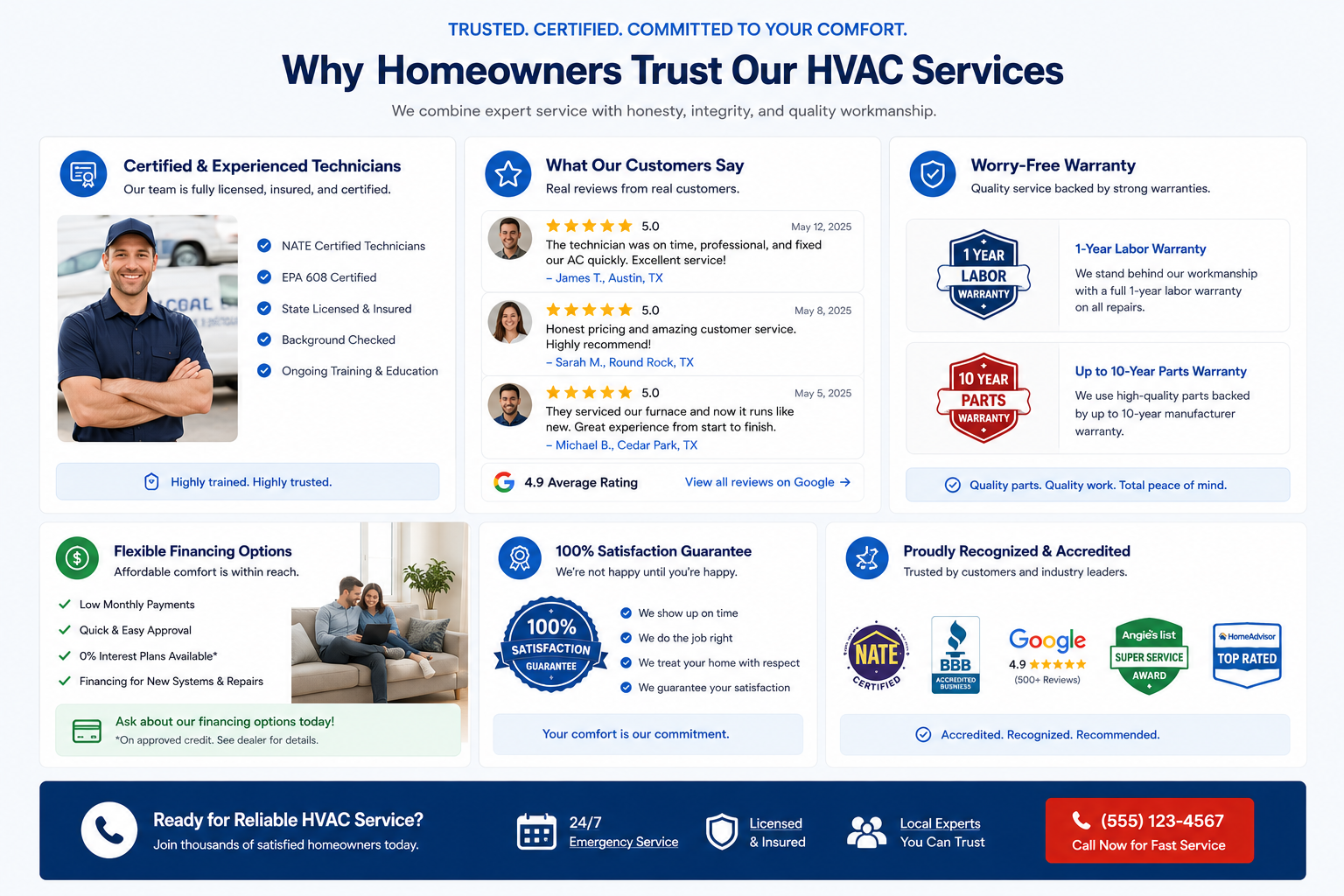
Optimize Your Titles and Meta Descriptions
Your page title is often the first thing people see in Google search results.
Instead of:
HVAC Services
Use something specific and compelling, such as:
AC Repair Services in Dallas, TX | Same-Day HVAC Experts
Likewise, your meta description should encourage clicks.
For example:
Need fast AC repair in Dallas? Our licensed HVAC technicians provide same-day service, upfront pricing, and trusted repairs. Call today for expert assistance.
Well-crafted titles and descriptions improve click-through rates, which can indirectly support SEO performance.
Internal Linking: Keep Visitors Exploring
Every page on your website should guide visitors to related information.
For example, from an AC Repair page, you might naturally link to:
- HVAC Maintenance Plans
- Emergency HVAC Repair
- Indoor Air Quality Services
- Contact Page
- HVAC SEO Case Study (for prospective HVAC business clients)
- HVAC SEO Services
- Local SEO Services
These links help users discover more content while allowing Google to understand the relationships between pages.
Avoid adding links just for the sake of it. Every internal link should provide additional value.
Pro Tip
Internal linking is one of the most overlooked SEO opportunities. It distributes authority across your website, improves crawlability, and keeps visitors engaged longer—all of which can contribute to stronger rankings.
Use Images That Build Confidence
Images are not just decorative.
For HVAC companies, they demonstrate professionalism and authenticity.
Consider including:
- Service technicians at work
- Branded service vehicles
- Equipment installations
- Before-and-after projects
- Team photos
- Maintenance inspections
- Customer interactions (with permission)
Optimize every image by:
- Compressing file sizes for faster loading
- Using descriptive file names (e.g.,
ac-repair-dallas-technician.jpg) - Adding relevant alt text
- Choosing modern formats such as WebP where supported
These practices improve accessibility, page speed, and image search visibility.
Real-World Insight
At Jaseir, we often find that improving on-page SEO alone can significantly increase lead generation without adding new traffic. By restructuring service pages, clarifying messaging, strengthening internal links, and emphasizing trust signals, HVAC businesses can convert a higher percentage of existing visitors into paying customers. This optimization process is demonstrated in our HVAC SEO Case Study (Internal Link: /case-studies/hvac-seo-services/).
On-Page SEO Checklist
Before publishing any HVAC service page, verify that it includes:
✔ A unique, keyword-focused title tag
✔ A compelling meta description
✔ One clear H1 heading
✔ Logical H2 and H3 subheadings
✔ Helpful, original content
✔ Strong trust signals
✔ Optimized images with alt text
✔ Clear call-to-action buttons
✔ Internal links to related services
✔ Mobile-friendly design
✔ Fast loading speed
✔ Easy contact options
Key Takeaways
- Every major HVAC service should have its own optimized landing page.
- Focus on solving customer problems, not just inserting keywords.
- Build trust with reviews, certifications, guarantees, and real project photos.
- Use strategic internal linking to improve navigation and SEO.
- Optimize titles, meta descriptions, images, and page structure for both users and search engines.
Technical HVAC SEO: The Invisible Foundation Behind Higher Google Rankings
Imagine building the perfect HVAC website.
You invest in professional copywriting.
You publish detailed service pages.
You earn five-star reviews.
You create helpful blog content.
But your pages still struggle to rank.
Why?
Because Google can't fully understand, crawl, or trust your website.
This is where Technical SEO becomes essential.
Unlike content or Local SEO, Technical SEO happens behind the scenes. Your customers may never notice it—but Google certainly does.
Think of it like an HVAC system.
Homeowners admire the comfortable temperature inside their homes, not the ductwork hidden behind the walls.
Technical SEO works the same way.
Visitors notice a fast, reliable website. Google notices the technical foundation that makes that experience possible.
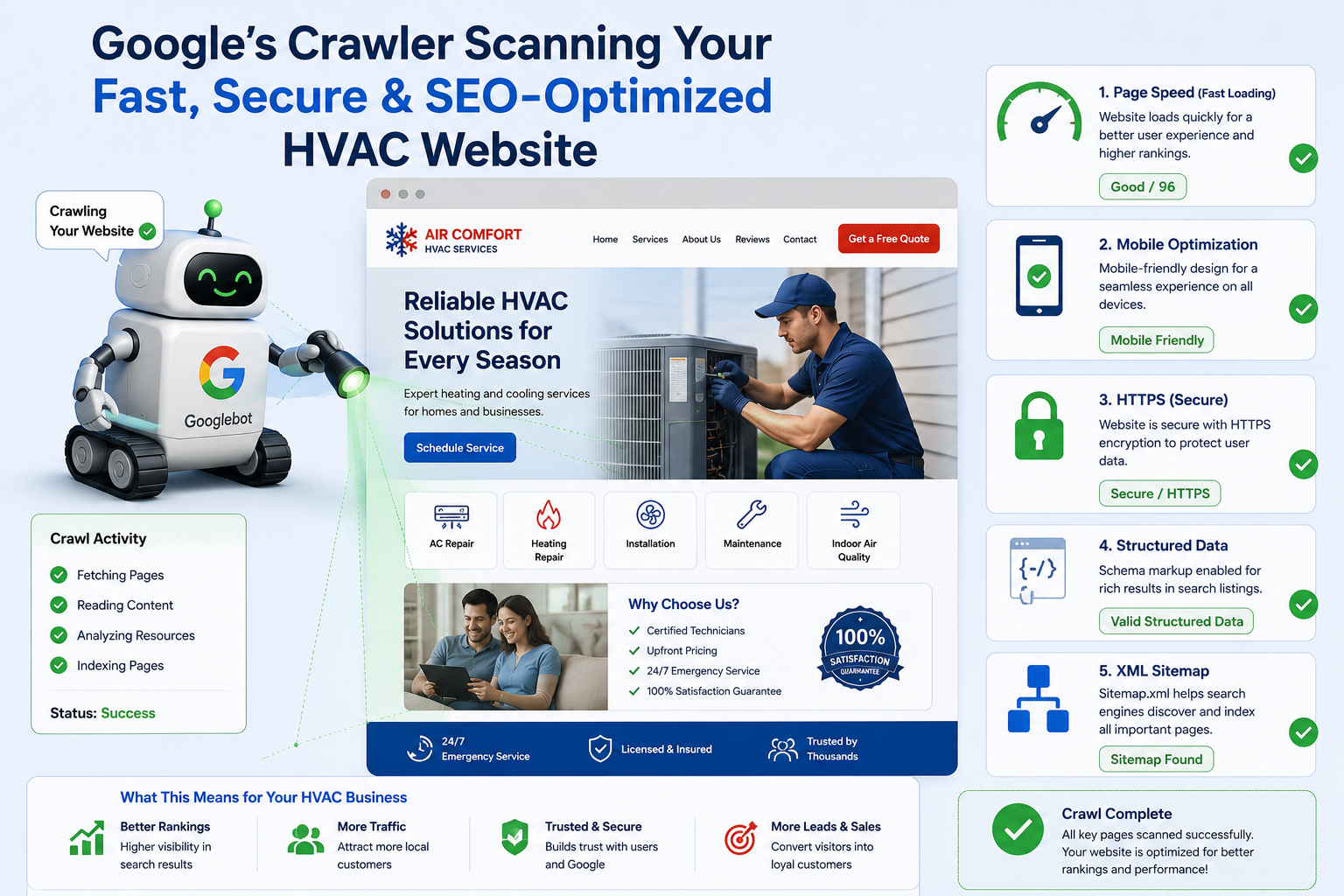
What Is Technical SEO?
Technical SEO is the process of optimizing your website so search engines can efficiently:
- Discover your pages
- Crawl your content
- Understand your information
- Index important pages
- Deliver a fast user experience
Without a solid technical foundation, even the best-written content can struggle to perform.
Think of Technical SEO as building the roads that allow Google to reach every important page on your website.
Why Technical SEO Matters for HVAC Companies
Google wants to recommend businesses that provide an excellent user experience.
Imagine a homeowner searching for:
Emergency AC Repair Near Me
They click your website.
But then...
- The page takes eight seconds to load.
- Images appear broken.
- The phone number is difficult to tap.
- Buttons overlap on mobile devices.
- The contact form doesn't work.
Most visitors won't wait.
They'll leave and call another HVAC company.
Google measures these user behaviors.
If people consistently abandon your website, your rankings can suffer over time.
Technical SEO helps eliminate these friction points.
Website Speed: Every Second Matters
Speed has become one of the most important website performance factors.
HVAC customers often search during stressful situations:
- AC stopped working
- Furnace won't start
- No heating during winter
- Emergency HVAC repair
They're looking for immediate solutions.
A slow website creates frustration before you've even had the opportunity to earn their trust.
A fast website:
- Keeps visitors engaged
- Improves conversion rates
- Reduces bounce rates
- Enhances mobile experience
- Helps search engines crawl more efficiently
Common Causes of Slow HVAC Websites
Many HVAC websites become slow because of avoidable issues.
Examples include:
- Oversized images
- Poor-quality hosting
- Too many WordPress plugins
- Unoptimized JavaScript
- Heavy page builders
- Auto-playing videos
- Large image sliders
- Excessive tracking scripts
Improving these areas often produces noticeable performance gains.
Expert Tip
Before adding another plugin or animation, ask yourself:
"Will this help my customer book an HVAC service?"
If the answer is no, it may be slowing down your website without adding real value.
Mobile Optimization Is No Longer Optional
Today, most HVAC searches happen on mobile devices.
Someone with a broken air conditioner isn't likely to wait until they get home and open a desktop computer.
They're searching from:
- Their phone
- Their tablet
- Their workplace
- Their vehicle
- Their living room
Google primarily evaluates the mobile version of your website when determining rankings.
That means your mobile experience deserves as much attention as your desktop design.
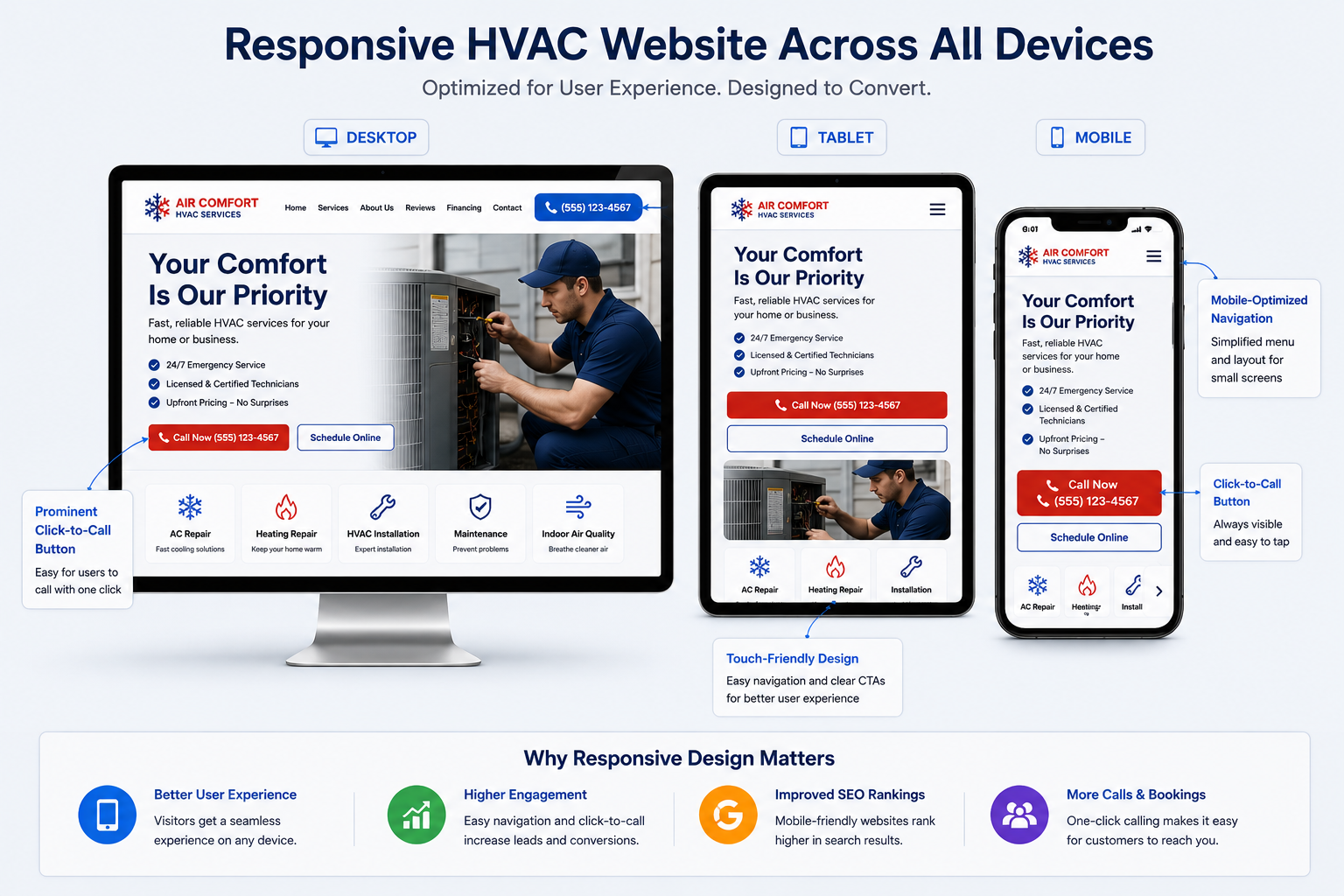
A mobile-friendly HVAC website should include:
- Large, easy-to-tap buttons
- Click-to-call phone numbers
- Simple navigation
- Readable text without zooming
- Fast-loading images
- Short contact forms
Every additional step increases the chance that a visitor will leave before contacting your business.
Secure Websites Build Trust
Would you trust a business website displaying a browser warning that says:
"This site is not secure."
Neither would your customers.
Google also considers website security when evaluating quality.
Every HVAC website should use HTTPS encryption.
Benefits include:
- Protecting customer information
- Securing contact forms
- Improving visitor confidence
- Supporting SEO best practices
Security isn't just about rankings—it's about professionalism.
Make It Easy for Google to Crawl Your Website
Google discovers your pages by following links.
If your website has:
- Broken navigation
- Dead links
- Orphan pages
- Duplicate URLs
Google may miss important content.
Every valuable page should be connected through logical internal linking.
Examples include:
Homepage
↓
HVAC Services
↓
AC Repair
↓
Emergency AC Repair
↓
Maintenance Plans
↓
Related Blog Articles
This structure helps both users and search engines navigate your website efficiently.
XML Sitemap: Your Website’s Roadmap
An XML sitemap tells Google:
"These are the pages I want you to crawl."
It should include:
- Homepage
- Service pages
- City pages
- Blog posts
- Case studies
- Important landing pages
Whenever you publish new content, your sitemap should update automatically.
Most modern SEO plugins handle this, but it's important to verify that your sitemap is functioning correctly.
Robots.txt: Guiding Search Engines
Your robots.txt file tells search engines which areas of your website they should or shouldn't crawl.
For most HVAC websites, this file is relatively simple.
However, mistakes can accidentally block Google from indexing important pages.
This is one reason technical SEO audits are valuable—they help identify issues that aren't visible during everyday website use.
Structured Data (Schema Markup)
Schema markup provides additional context about your business.
It helps Google understand:
- Your company name
- Services
- Phone number
- Address
- Business hours
- Reviews
- FAQs
- Service areas
Proper schema can improve how your website appears in search results and increase click-through rates.
For HVAC companies, useful schema types include:
- Local Business
- HVAC Business
- Service
- FAQ
- Review
- Breadcrumb
- Organization
Although users never see schema directly, search engines rely on it to interpret your content more accurately.
Technical SEO Checklist
Before launching or auditing your HVAC website, ensure you have:
✔ Fast loading pages
✔ Mobile-friendly design
✔ HTTPS security
✔ Working XML sitemap
✔ Proper robots.txt configuration
✔ No broken internal links
✔ Optimized images
✔ Structured data (Schema)
✔ Clear URL structure
✔ No duplicate content issues
✔ Functional contact forms
✔ Click-to-call functionality
Real-World Insight
At Jaseir, technical SEO is one of the first areas we evaluate during every HVAC SEO engagement. It's common to find hidden issues—such as slow-loading pages, crawl errors, or improperly configured schema—that limit a website's ability to rank despite having strong content. Addressing these technical barriers often creates the foundation for sustained organic growth. You can explore a practical example in our HVAC SEO Case Study
Key Takeaways
- Technical SEO ensures Google can efficiently crawl, understand, and rank your website.
- Fast-loading, mobile-friendly websites provide a better user experience and support stronger rankings.
- Security, structured data, XML sitemaps, and clean site architecture all contribute to long-term SEO performance.
- Technical issues often remain invisible to business owners but can significantly impact lead generation.
- A technically optimized website allows every other SEO effort—from content creation to Local SEO—to perform more effectively.
Google Business Profile Optimization for HVAC Companies: Your Fastest Path to More Local Leads
Imagine two HVAC companies operating in the same city.
Both offer quality service.
Both have experienced technicians.
Both have professional websites.
Yet one company receives significantly more phone calls from Google.
Why?
In many cases, the difference isn't their website—it's their Google Business Profile (GBP).
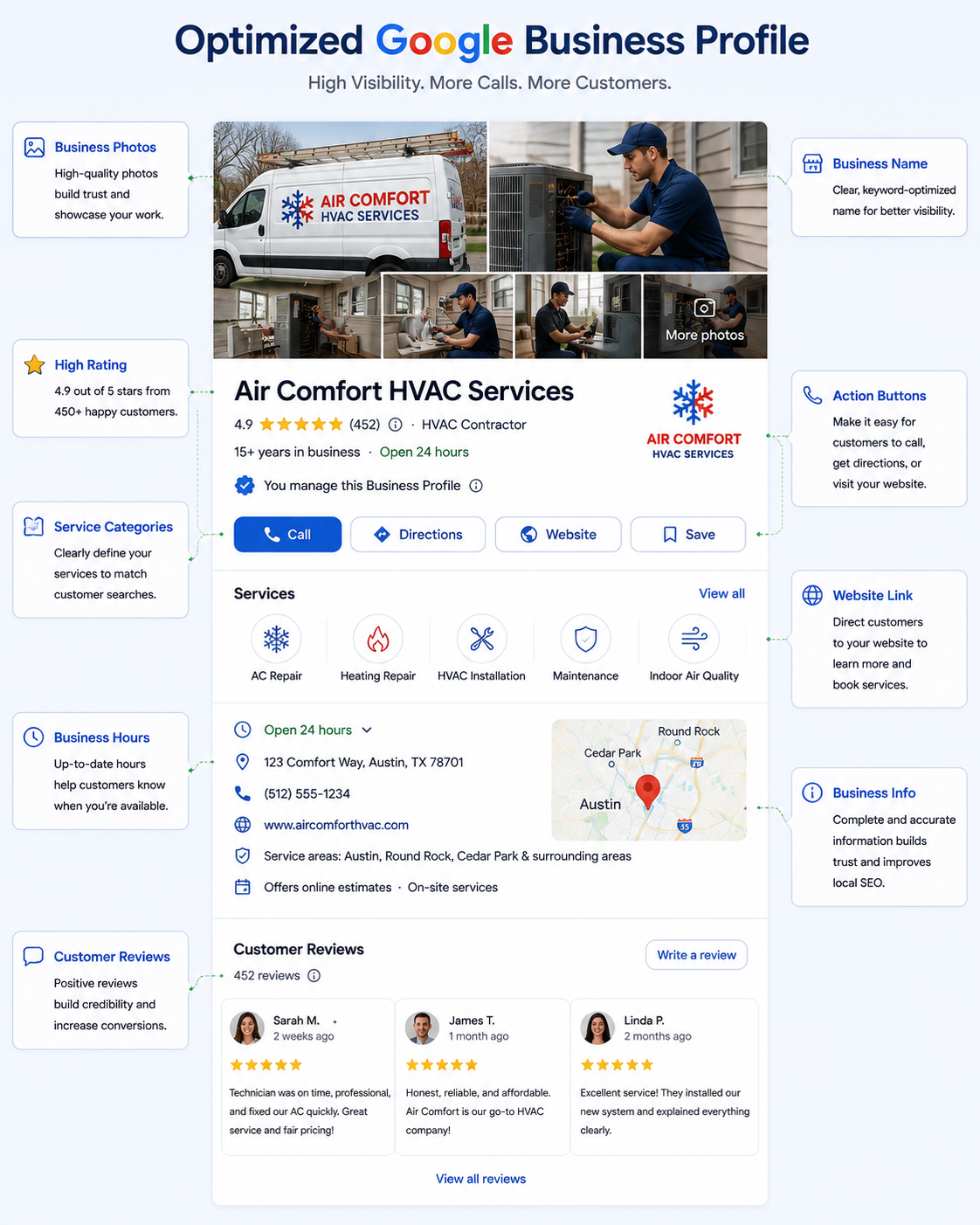
For HVAC businesses, your Google Business Profile is often the first impression potential customers have of your company. Before they visit your website, they can see your reviews, photos, business hours, phone number, location, service areas, and even ask questions directly from Google.
When someone searches:
- AC Repair Near Me
- HVAC Contractor Dallas
- Emergency Furnace Repair
- Heat Pump Installation Houston
Google often displays the Local Map Pack before the traditional organic search results.
If your business appears there, you've already gained a significant competitive advantage.
If it doesn't, your competitors are likely receiving those calls instead.
Why Google Business Profile Matters for HVAC SEO
Many HVAC business owners assume their website alone determines rankings.
That's no longer true.
Google Business Profile influences:
- Local Map Pack visibility
- Google Maps rankings
- Mobile search visibility
- Voice search results
- Click-to-call actions
- Driving directions
- Customer trust
- Local brand awareness
For many service-area businesses, Google Business Profile generates more leads than the website itself.
That's why optimizing it should be one of your highest priorities.
Step 1: Complete Every Section of Your Profile
Google prefers businesses that provide complete, accurate, and up-to-date information.
Don't leave fields blank.
Your profile should include:
Business Name
Use your real business name.
Avoid adding keywords like:
❌ Best HVAC Company Dallas
❌ Cheap AC Repair Houston
Google considers keyword stuffing in business names a violation of its guidelines.
Primary Category
Choose the category that best represents your main business.
For most companies, this is:
HVAC Contractor
Depending on your services, relevant secondary categories may include:
- Air Conditioning Repair Service
- Heating Contractor
- Air Conditioning Contractor
- Commercial Refrigeration
- Air Duct Cleaning Service
Selecting the right categories helps Google understand when your business should appear in local searches.
Business Description
Your business description should explain:
- Who you are
- What services you provide
- Where you serve customers
- What makes your company different
Avoid writing a list of keywords.
Instead, write naturally.
Example:
"Jaseir helps HVAC companies improve their online visibility through specialized SEO strategies, Local SEO, and content marketing designed to generate qualified leads and long-term organic growth."
For HVAC contractors, your description should focus on your expertise, service areas, years of experience, and commitment to customer satisfaction.
Step 2: Define Your Service Areas
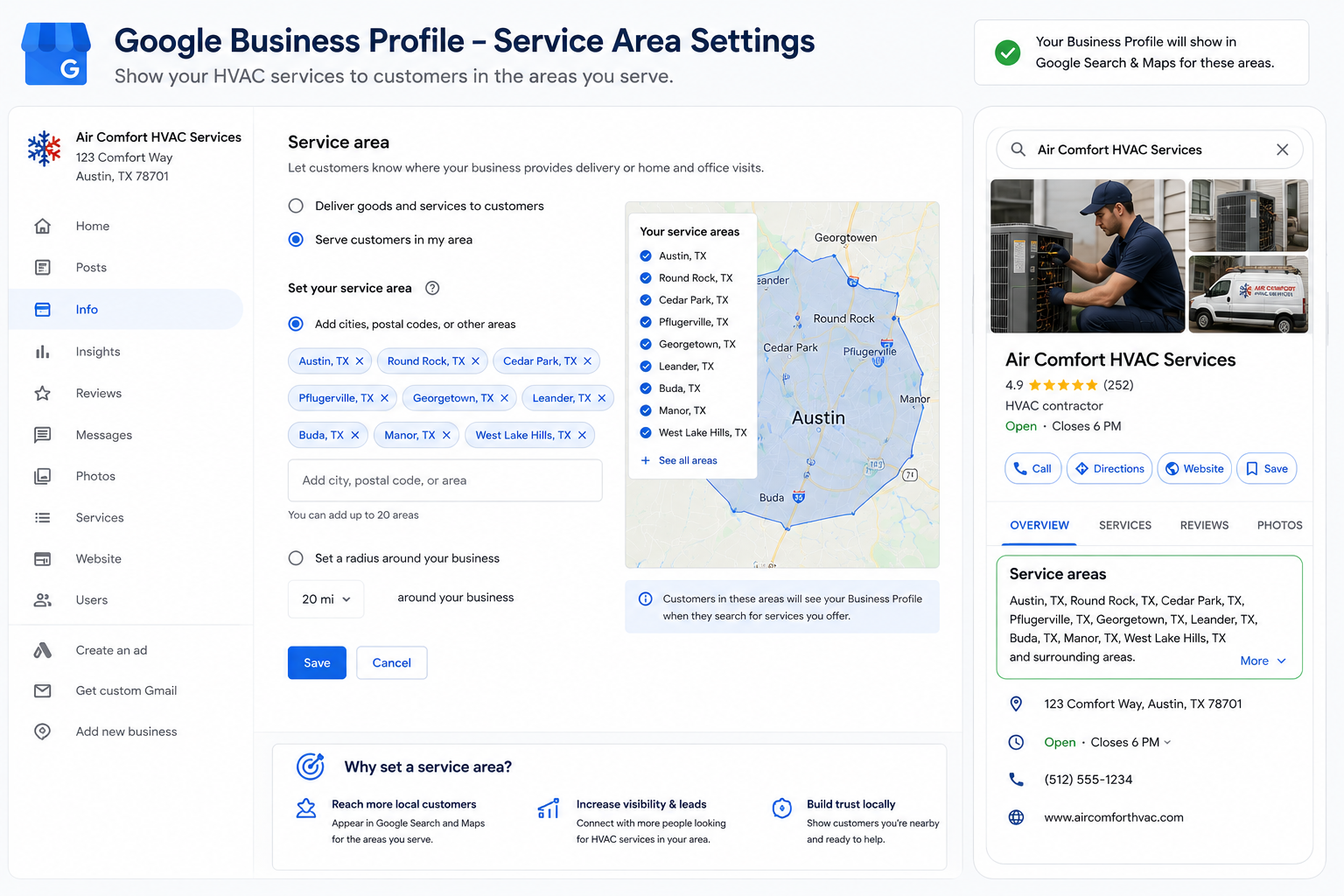
Google allows HVAC companies to specify the cities and regions they serve.
Be specific.
Instead of selecting an entire state, identify the actual cities and communities where your technicians operate.
For example:
- Dallas
- Plano
- Irving
- Richardson
- Garland
- Frisco
This helps Google associate your business with local searches in those areas.
Step 3: Showcase Your Services
One of the most underused features in Google Business Profile is the Services section.
Rather than listing "HVAC Services" as a single item, break them into individual offerings.
For example:
Cooling Services
- AC Repair
- AC Installation
- AC Replacement
- AC Maintenance
- Ductless Mini Split Installation
Heating Services
- Furnace Repair
- Furnace Installation
- Heat Pump Repair
- Heat Pump Installation
- Boiler Services
Indoor Comfort
- Indoor Air Quality
- Air Purification
- Humidifiers
- Thermostat Installation
- Duct Cleaning
The more clearly you define your services, the easier it is for Google to match your profile with relevant searches.
Expert Insight
We often see HVAC companies overlook the Services section or keep it too generic. Expanding it with detailed, customer-focused service listings helps reinforce relevance for specific search queries and improves the overall quality of the profile.
Step 4: Add High-Quality Photos Regularly
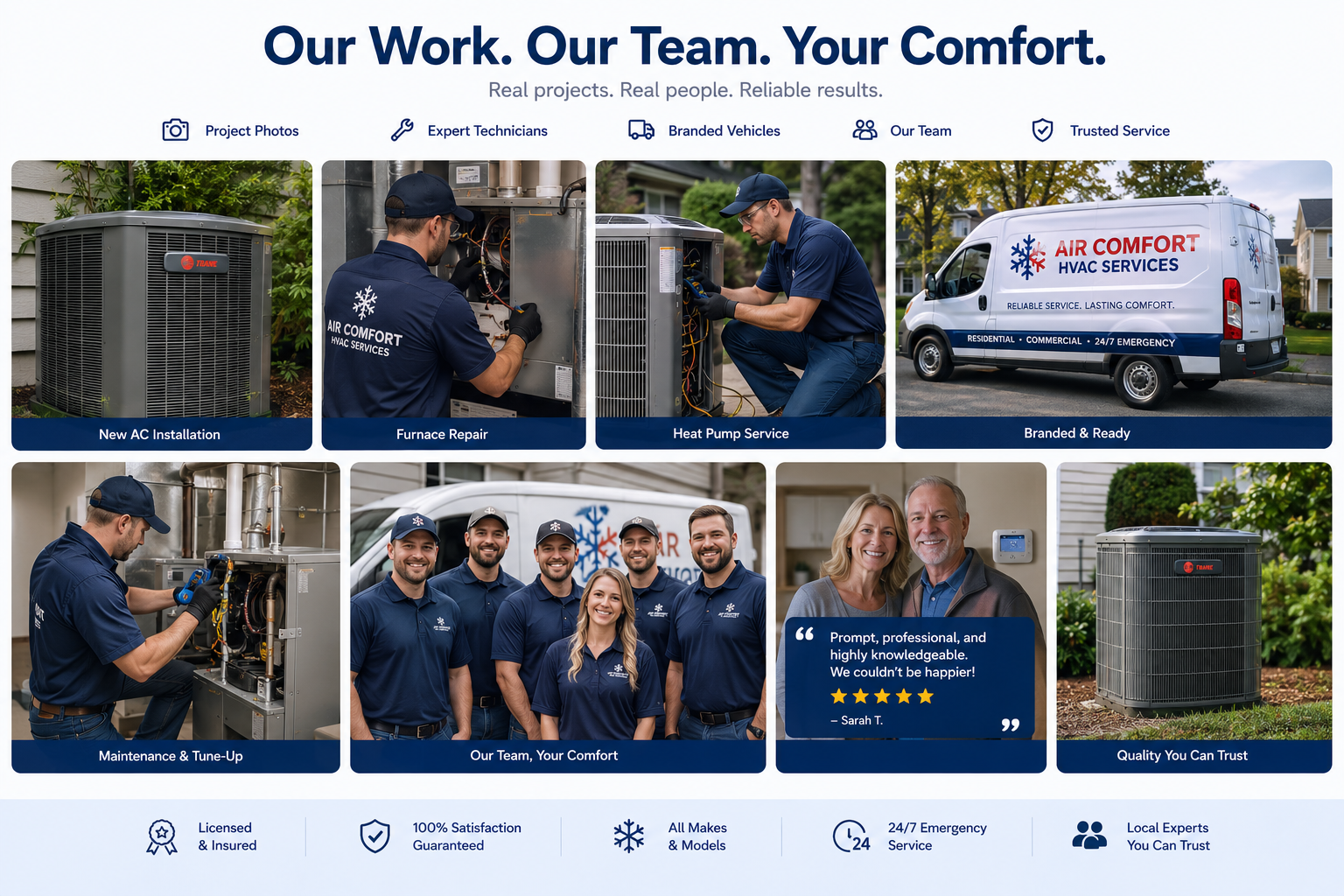
Customers trust businesses that look active.
Google also favors profiles that remain updated.
Upload authentic images such as:
- HVAC technicians at work
- Service vehicles
- Equipment installations
- Maintenance visits
- Team photos
- Office exterior
- Warehouse
- Before-and-after projects
- Branded uniforms
- Completed installations
Avoid relying solely on stock photography.
Real photos build credibility and help potential customers feel confident about choosing your company.
Step 5: Reviews Are One of Your Strongest Ranking Signals
Think about your own buying habits.
Would you choose:
Business A — 8 reviews
or
Business B — 450 reviews with a 4.9-star rating?
Most customers choose the second option.
Google notices this too.
While reviews aren't the only ranking factor, they significantly influence customer trust and local prominence.
Encourage satisfied customers to leave detailed reviews mentioning:
- The service they received
- The city where work was completed
- Their overall experience
For example:
"Our AC stopped working during a heatwave in Plano. The technician arrived the same day, explained the issue clearly, and had our system running again within hours. Excellent service."
These natural mentions reinforce your local relevance without appearing forced.
Respond to Every Review
Whether the feedback is positive or negative, always respond professionally.
A thoughtful response demonstrates that your business values customer relationships.
When replying:
- Thank the customer.
- Reference the service provided.
- Keep responses personalized.
- Avoid generic copy-and-paste replies.
This creates a stronger impression for future customers reading your reviews.
Common Google Business Profile Mistakes
Avoid these frequent issues:
❌ Inconsistent business information across directories
❌ Keyword stuffing in the business name
❌ Outdated business hours
❌ Very few or no recent photos
❌ Ignoring customer reviews
❌ Listing services too broadly
❌ Incomplete profile fields
❌ No website link
❌ Incorrect primary category
Even small inaccuracies can reduce trust and impact your local visibility.
Google Business Profile Optimization Checklist
Before moving forward, confirm that your profile includes:
✔ Accurate business name
✔ Correct primary and secondary categories
✔ Detailed business description
✔ Clearly defined service areas
✔ Individual service listings
✔ High-quality project photos
✔ Regularly updated images
✔ Consistent business information
✔ Strong review strategy
✔ Professional responses to reviews
✔ Website link
✔ Appointment or contact options where applicable
Real-World Insight
At Jaseir, Google Business Profile optimization is one of the first areas we assess when working with HVAC businesses. We've found that strengthening profile completeness, improving service categorization, enhancing visual content, and developing a consistent review strategy often leads to noticeable improvements in local visibility—even before broader SEO initiatives begin. You can see how these efforts fit into a comprehensive strategy in our HVAC SEO Case Study (Internal Link: /case-studies/hvac-seo-services/).
Key Takeaways
- Your Google Business Profile is often the first interaction customers have with your HVAC business.
- A complete, accurate, and regularly updated profile improves local search visibility.
- Detailed service listings and clearly defined service areas help Google match your business with relevant searches.
- Authentic photos and consistent customer reviews strengthen trust and local prominence.
- Managing your profile proactively can generate qualified leads directly from Google Maps and local search results.


