
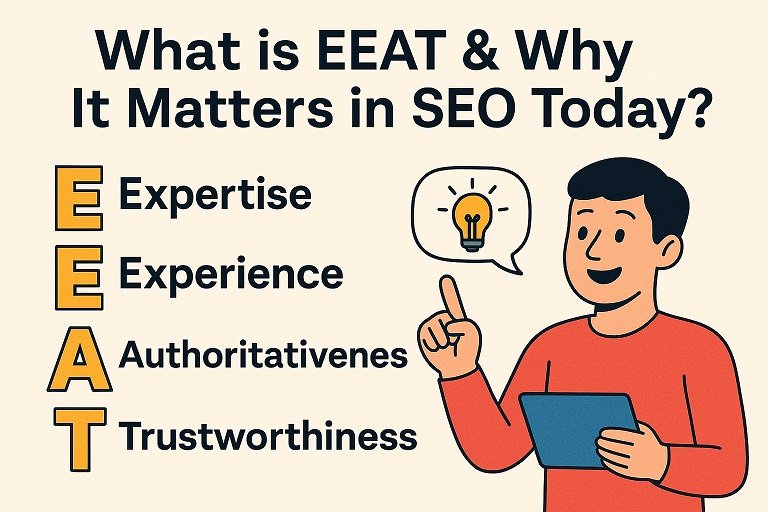
Google’s search algorithm continues to evolve, and one of the most important concepts shaping rankings today is EEAT Expertise, Experience, Authoritativeness, and Trustworthiness. These are now considered essential EEAT guidelines that help Google evaluate how credible, useful, and safe your content is for users. Simply put, Google wants to show information from sources that are knowledgeable, proven, and trusted especially in industries where accuracy matters.
SEO is no longer just about keywords, backlinks, or technical tweaks.
Google now puts enormous weight on something deeper credibility.
This approach is called EEAT, which stands for Expertise, Experience, Authoritativeness, and Trustworthiness.
It is Google’s way of determining which content genuinely deserves visibility especially on topics that affect health, finance, education, safety, or life decisions.
The Evolution from E-A-T to E-E-A-T
Originally, Google used the model E-A-T:
-
Expertise
-
Authoritativeness
-
Trustworthiness
In 2022, Google added another E — Experience, recognizing that first hand insight makes content more useful and reliable.
For example:
A travel guide written by someone who has been to the destination is more meaningful than one created purely from research.
That’s why Google now rewards pages that show lived experience, not just theoretical knowledge.
Breaking Down the Four Elements of EEAT
1. Expertise
Google wants content created by people who genuinely understand what they are talking about.
This could be formal qualifications or proven knowledge.
2. Experience
People trust insights drawn from real-world involvement:
✔ Reviews
✔ Personal stories
✔ Case studies
✔ Demonstrated usage
Google does too.
3. Authoritativeness
Authority is built when others recognise you or your brand as a reliable source:
-
Mentions
-
Quality backlinks
-
Press coverage
-
Strong reputation in your field
4. Trustworthiness
Trust is the backbone of ranking.
This includes:
-
Accurate information
-
Clear policies
-
Secure website (HTTPS)
-
Transparent contact details
Without trust, EEAT collapses — even if other signals are strong.
Why EEAT Matters More Than Ever
Today, misinformation online is a major concern. Google’s response is tightening quality expectations.
According to Google Search Central’s EEAT recommendations, Google rewards content that shows real expertise, useful experience, and author transparency not just optimized keywords.
If your website gives advice on finance, health, education, or business — Google will only rank you high if you prove credibility.
That makes EEAT not just a ranking factor, but a brand-building strategy.
How You Can Improve EEAT
Here are practical steps every website can take:
✔ Add author bios with credentials
✔ Share case studies & testimonials
✔ Publish original insights & experiences
✔ Get featured on reputable platforms
✔ Strengthen security & transparency
✔ Avoid copied or superficial content
The more signals you build, the better your EEAT score — and the stronger your organic presence.
Final Thoughts
SEO is shifting away from hacks and towards trust, expertise, and authenticity.
Websites that educate, verify, and prove credibility will win — not just rankings, but audience confidence too.
If you create content or run a business online, focusing on EEAT is no longer optional. it’s how you stay relevant in Google’s evolving ecosystem.
✔ Conclusion
In today’s competitive digital landscape, following Google’s EEAT guidelines is not optional it is the foundation for building trust, improving rankings, and creating meaningful, user-first content.
What is EEAT in SEO?
EEAT stands for Experience, Expertise, Authoritativeness, and Trustworthiness. It is Google’s quality framework used to evaluate whether a website and its content creators are credible, reliable, and valuable to users.
Does EEAT affect Google rankings?
Yes. While EEAT is not a direct ranking factor, it strongly influences how Google evaluates content quality. Websites with strong EEAT signals tend to rank better, especially for sensitive or high-impact topics such as finance, health, education, and business.
How can I improve EEAT on my website?
You can improve EEAT by:
-
Adding detailed author bios and credentials
-
Sharing real case studies and client results
-
Displaying testimonials and reviews
-
Securing your site with HTTPS
-
Providing clear contact and business information
-
Earning mentions, backlinks, and reviews from authoritative sources
Is EEAT only important for YMYL (Your Money or Your Life) websites?
EEAT is most critical for YMYL websites, but it applies to all types of content. Google uses EEAT principles across the web to assess credibility, accuracy, and trustworthiness.
Why did Google add “Experience” to EEAT?
Google added Experience to reward content based on firsthand knowledge. Content created by someone who has actually done, used, or lived through something often provides more accurate, practical, and trustworthy insights than content based only on research.


