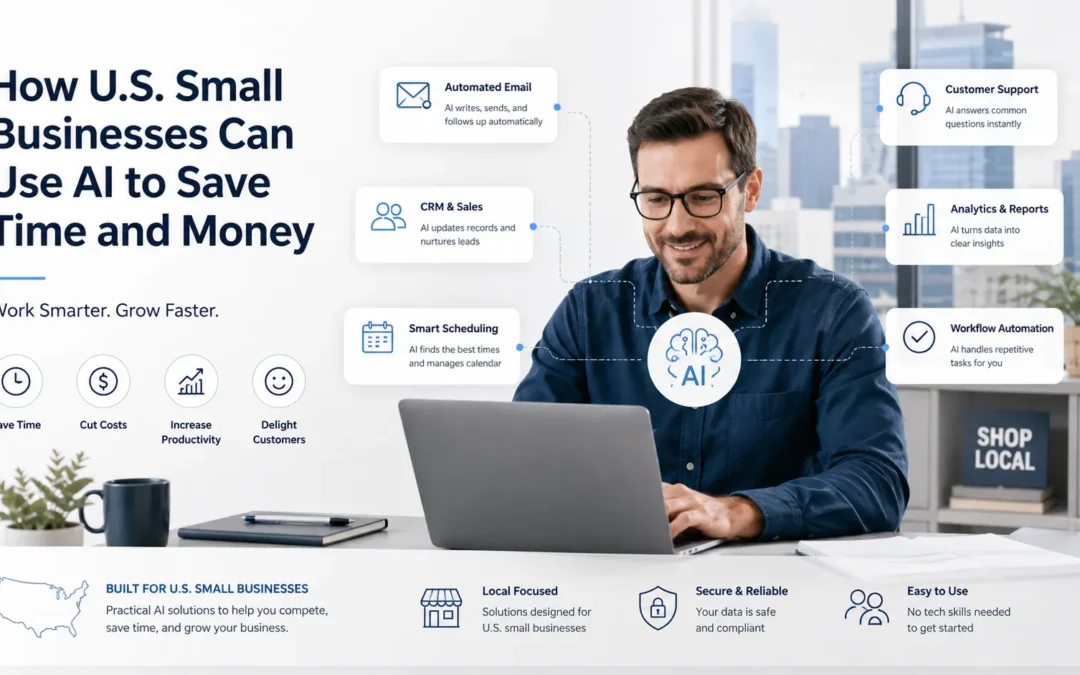
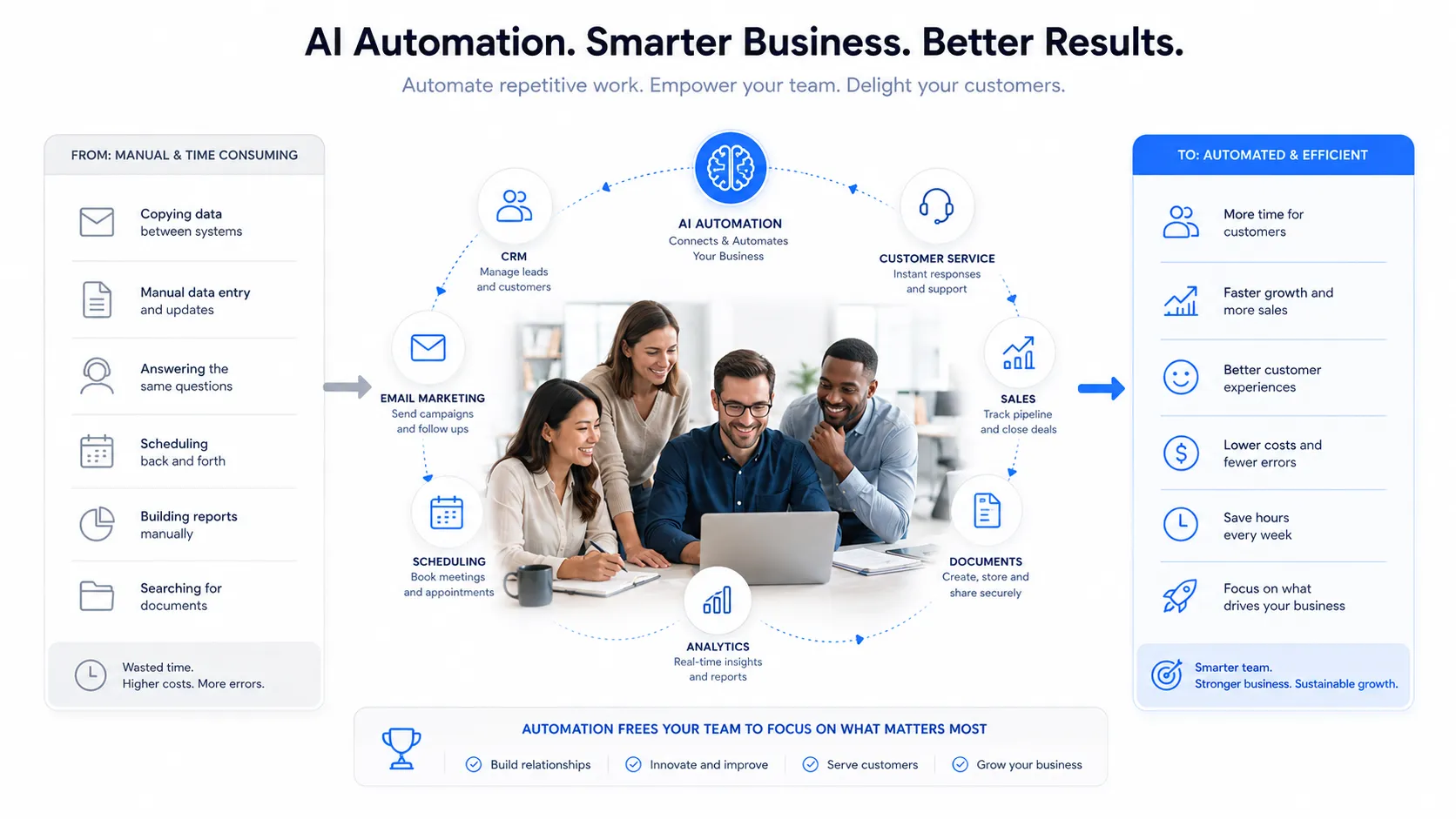
Running a small business in the United States often means doing more with fewer resources. Business owners and their teams may spend hours every week answering emails, following up with leads, creating marketing content, scheduling appointments, preparing documents, entering data, and handling customer questions.
Artificial intelligence is changing that.
Today, small businesses can use affordable AI tools to automate repetitive work, improve customer service, create content faster, organize information, and support employees without making large technology investments.
The goal is not to replace your team with AI. The goal is to help your existing team accomplish more in less time.
According to recent U.S. research, AI adoption among small businesses is growing rapidly. The U.S. Chamber of Commerce Foundation reports that half of workers at small businesses now use AI at work, with most using it to improve productivity rather than eliminate jobs.
The U.S. Small Business Administration also recommends that small businesses start small, test AI tools, and determine whether they actually create value before expanding their use.
Why AI Matters for U.S. Small Businesses
Large companies have traditionally had the resources to invest in expensive software, automation teams, data analysts, and specialized employees.
Small businesses often don't.
A local contractor, marketing agency, dental office, law firm, real estate company, e-commerce store, accounting firm, or professional service business may have only a handful of employees.
That makes employee time extremely valuable.
AI can help small businesses:
- Reduce repetitive administrative work
- Respond to customers faster
- Create marketing content more efficiently
- Automate lead follow-ups
- Organize business information
- Summarize documents and meetings
- Improve internal communication
- Analyze business data
- Support sales teams
- Reduce the amount of manual data entry
Recent Federal Reserve research found that nearly 40% of small-business respondents were already using AI or planning to use it, showing how quickly the technology is moving into the small-business market.
Automate Repetitive Administrative Tasks
Administrative work can consume a surprising amount of time.
Employees may spend hours copying information between systems, organizing spreadsheets, preparing reports, sending routine emails, or entering customer information.
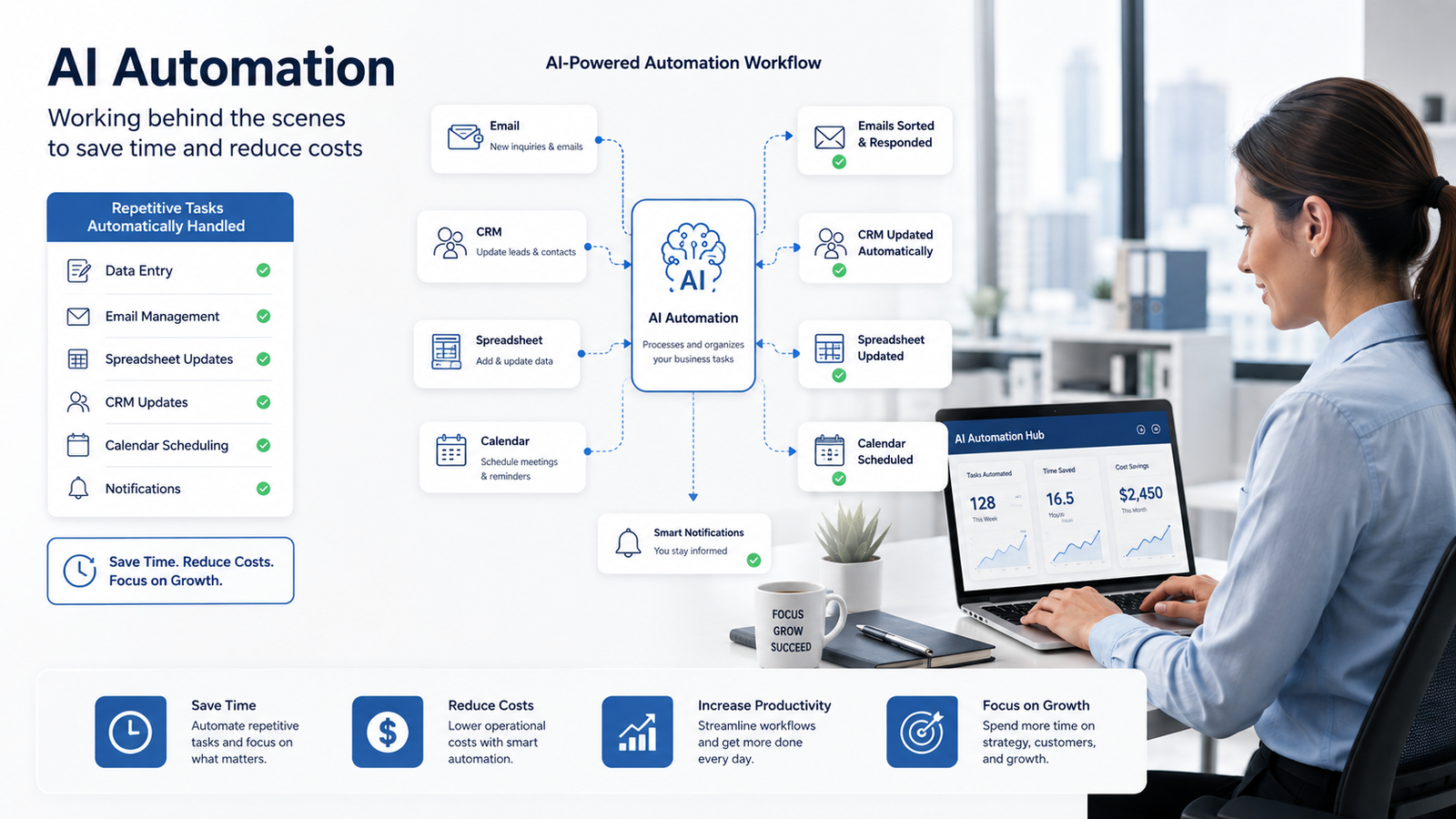
AI automation can connect different business applications and move information automatically.
For example:
New lead → CRM → Follow-up email → Sales notification → Appointment → Reminder
Instead of an employee manually completing every step, an automated workflow can handle much of the process.
A small business might connect its website forms, CRM, email platform, calendar, and internal communication tools so that information moves automatically between them.
Example
Imagine a plumbing company receives a quote request through its website.
Without automation:
- Employee receives the form.
- Employee enters the customer into the CRM.
- Employee sends an email.
- Employee notifies the salesperson.
- Employee schedules a follow-up.
- Employee remembers to follow up again.
With AI-powered automation, much of this workflow can happen automatically.
The employee can focus on the customer rather than administrative tasks.
2. Use AI for Customer Service
Customer questions are another major source of repetitive work.
Customers frequently ask:
- What are your business hours?
- Do you provide this service?
- How much does it cost?
- Where are you located?
- How can I schedule an appointment?
- What is your return policy?
- When will my order arrive?
AI-powered chatbots and virtual assistants can answer common questions instantly.
The SBA specifically identifies chatbots and automated phone services as practical AI applications for small businesses.
A small business can use AI to handle basic questions while allowing employees to take over more complicated conversations.
This creates a useful balance:
AI handles routine questions.
Employees handle important conversations.

3. Create Marketing Content Faster
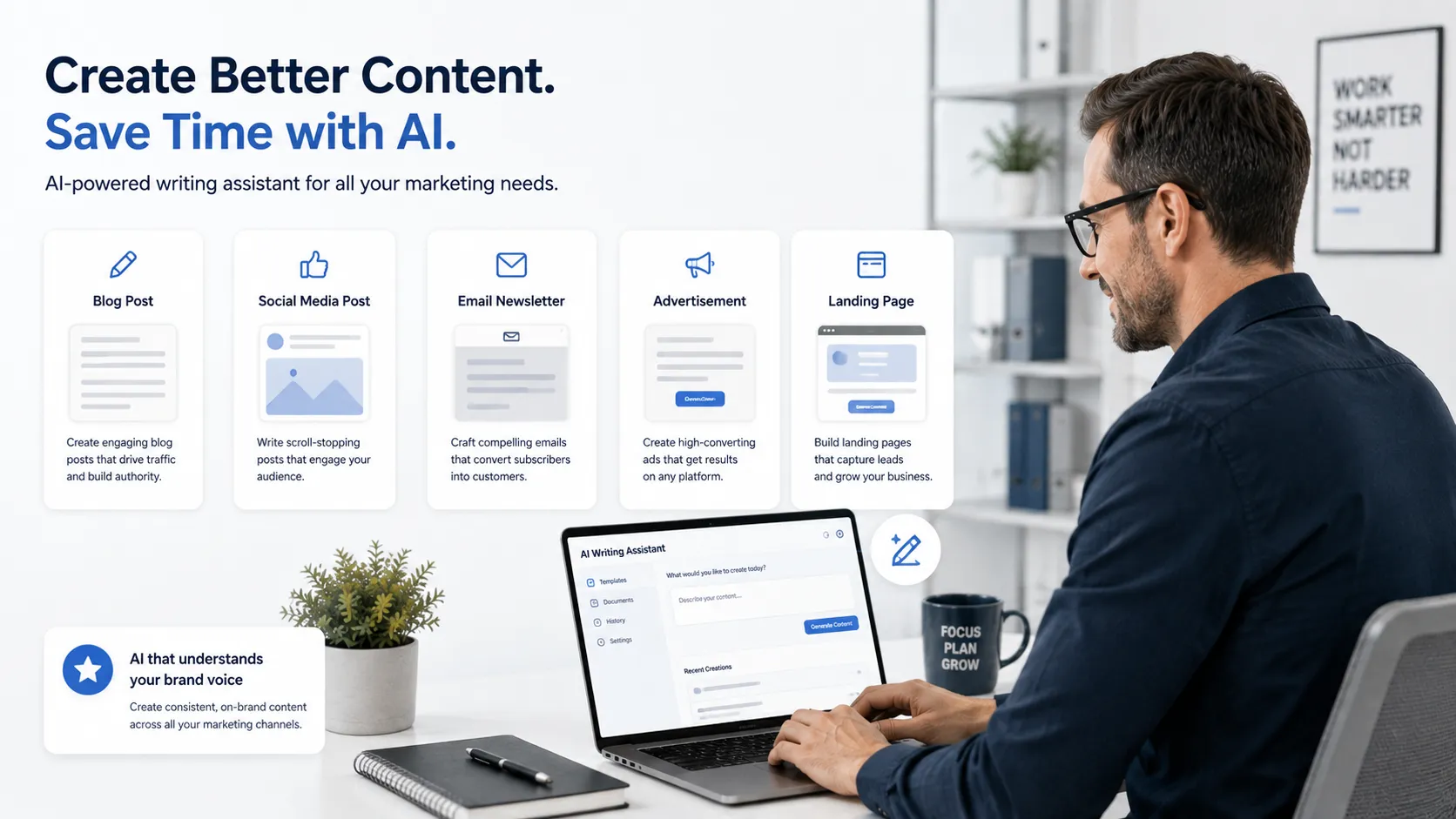
Marketing is essential for small businesses, but creating content consistently can take a lot of time.
AI can help businesses produce first drafts of:
- Blog posts
- Social media posts
- Email newsletters
- Product descriptions
- Ad copy
- Landing page content
- Video scripts
- Frequently asked questions
- Customer messages
For example, a local roofing company could provide AI with information about its services and ask it to create several social media post ideas.
An employee can then review, edit, and personalize the content before publishing it.
This can significantly reduce the time required to create marketing material.
However, businesses should not simply publish AI-generated content without review. Human expertise, factual accuracy, brand voice, and originality still matter.
4. Automate Lead Follow-Up
One of the biggest opportunities for small businesses is sales automation.
A business may generate leads through:
- Google Ads
- Website forms
- Local SEO
- Email campaigns
- Referrals
- Online directories
The problem is that leads can be forgotten.
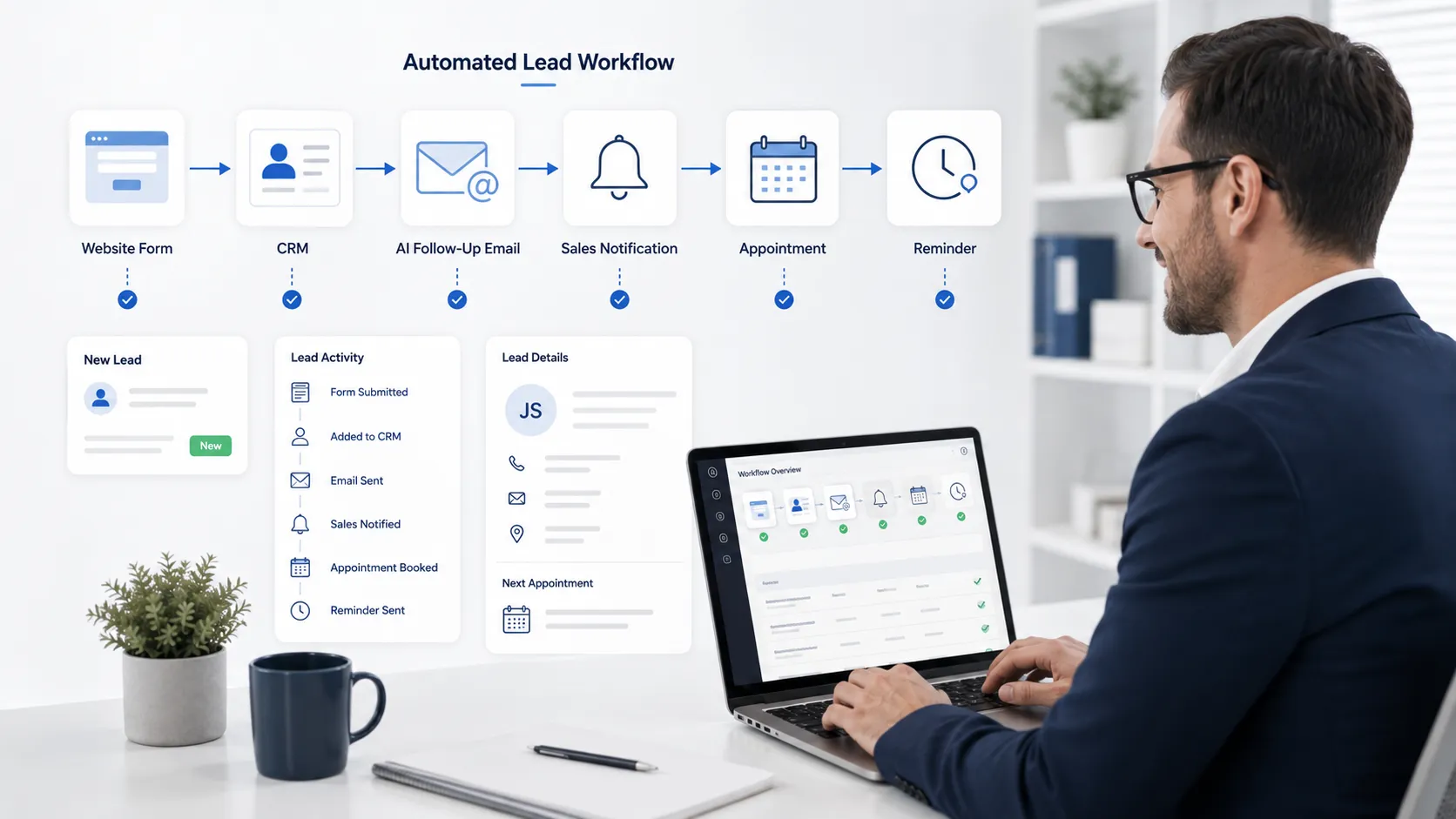
AI automation can help create a follow-up system.
For example:
Lead submits form → CRM record created → Personalized email sent → Salesperson notified → Follow-up reminder created → Lead receives additional information
This allows a small sales team to respond more consistently without manually managing every reminder.
Faster follow-up can be particularly valuable because a lead that receives no response may contact a competitor instead.
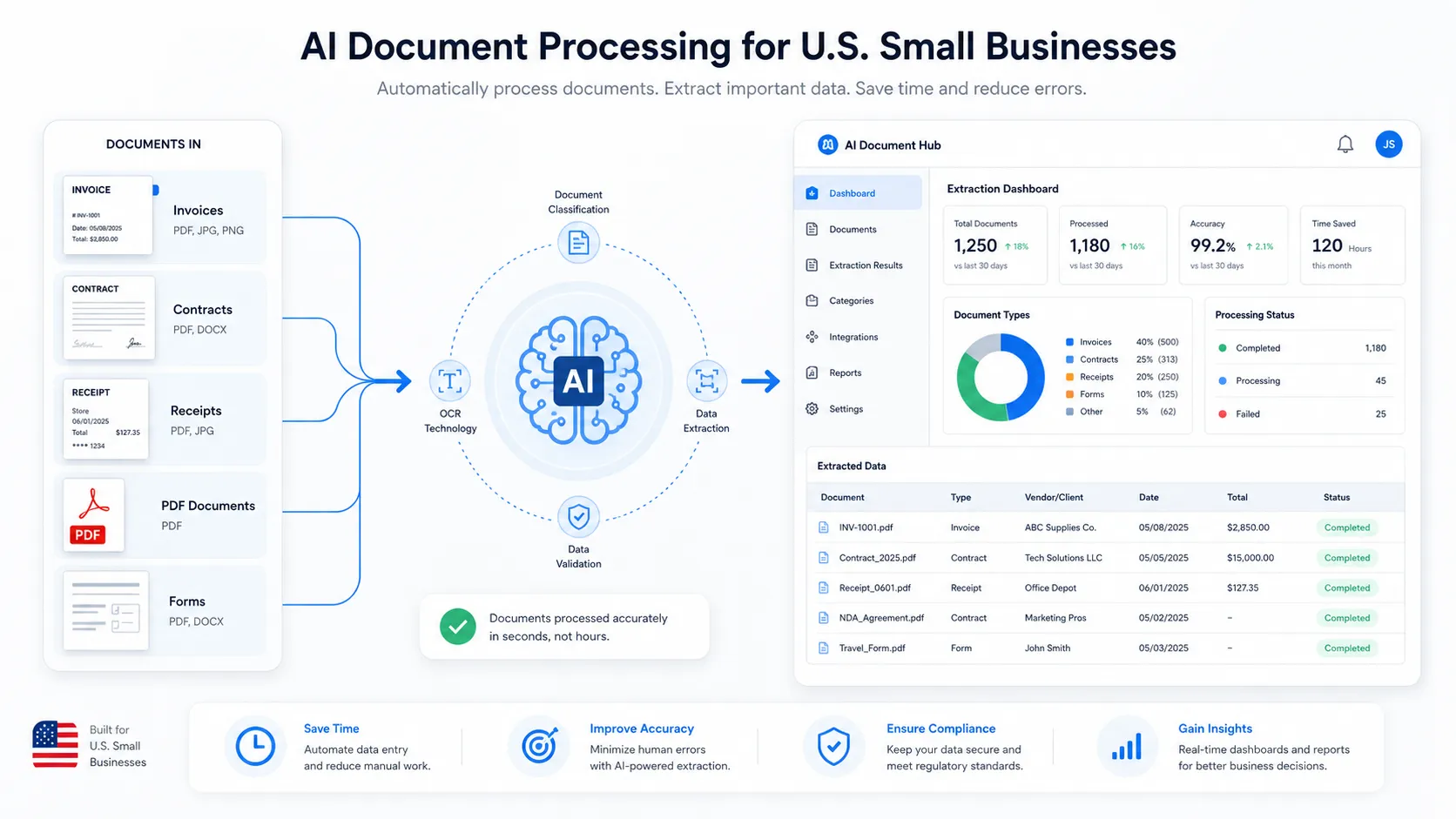
5. Use AI to Process Documents
Small businesses deal with documents every day.
These can include:
- Invoices
- Contracts
- Proposals
- Receipts
- Customer forms
- Reports
- PDFs
- Meeting notes
AI can help extract information, summarize documents, classify files, and organize data.
For example, an accounting or professional services company could use AI to extract important information from documents before sending it to the appropriate employee or software system.
Instead of spending time reading every document manually, employees can start with information that has already been organized.
6. Make Meetings More Productive
Meetings can consume significant amounts of employee time.
AI meeting assistants can help by:
- Transcribing meetings
- Summarizing discussions
- Identifying important decisions
- Creating action items
- Organizing notes
- Preparing follow-up messages
Instead of someone spending 30 minutes after a meeting writing notes, AI can create a first draft that employees review.
This is a simple use case that many small businesses can implement without changing their entire technology stack.
7. Use AI for Email Management
Email remains one of the biggest sources of workplace interruptions.
AI can help employees:
- Summarize long email threads
- Draft responses
- Categorize messages
- Identify urgent requests
- Extract tasks
- Create follow-up reminders
- Personalize customer communication
The important point is that AI does not necessarily need to send emails automatically.
A safer approach is often:
AI drafts → Employee reviews → Employee sends
As the business becomes more comfortable with the technology, selected low-risk emails can potentially be automated.
8. Improve Sales and CRM Operations
A CRM contains valuable information, but small businesses often don't use all of it effectively.
AI can analyze customer and sales information to help identify:
- Leads that need follow-up
- Customers who haven't purchased recently
- Sales opportunities
- Common customer questions
- Potential upsell opportunities
- Deals that may be slowing down
AI can also summarize customer interactions so sales representatives don't have to read an entire communication history before contacting a prospect.
This can make a small sales team more efficient without increasing headcount.
9. Use AI for Business Data and Reporting
Many small businesses have data but don't have dedicated analysts.
AI can help business owners understand information such as:
- Sales performance
- Marketing results
- Website traffic
- Customer acquisition
- Product performance
- Expenses
- Lead sources
Instead of manually examining spreadsheets, a business owner could ask questions such as:
“Which marketing channel generated the most qualified leads last month?”
or
“Which products experienced the biggest decline in sales?”
AI can help turn raw business data into easier-to-understand insights.
Human review is still important, particularly when decisions involve financial or operational consequences.
10. Automate Appointment Scheduling
Appointment-based businesses can benefit significantly from automation.
Examples include:
- Dentists
- Salons
- Medical practices
- Consultants
- Contractors
- Real estate professionals
- Cleaning companies
- Repair businesses
AI can help customers find available times, answer basic questions, send reminders, and reduce appointment-related administrative work.
This can save employees from repeatedly handling simple scheduling requests.
11. AI Can Help Small Businesses Save Money
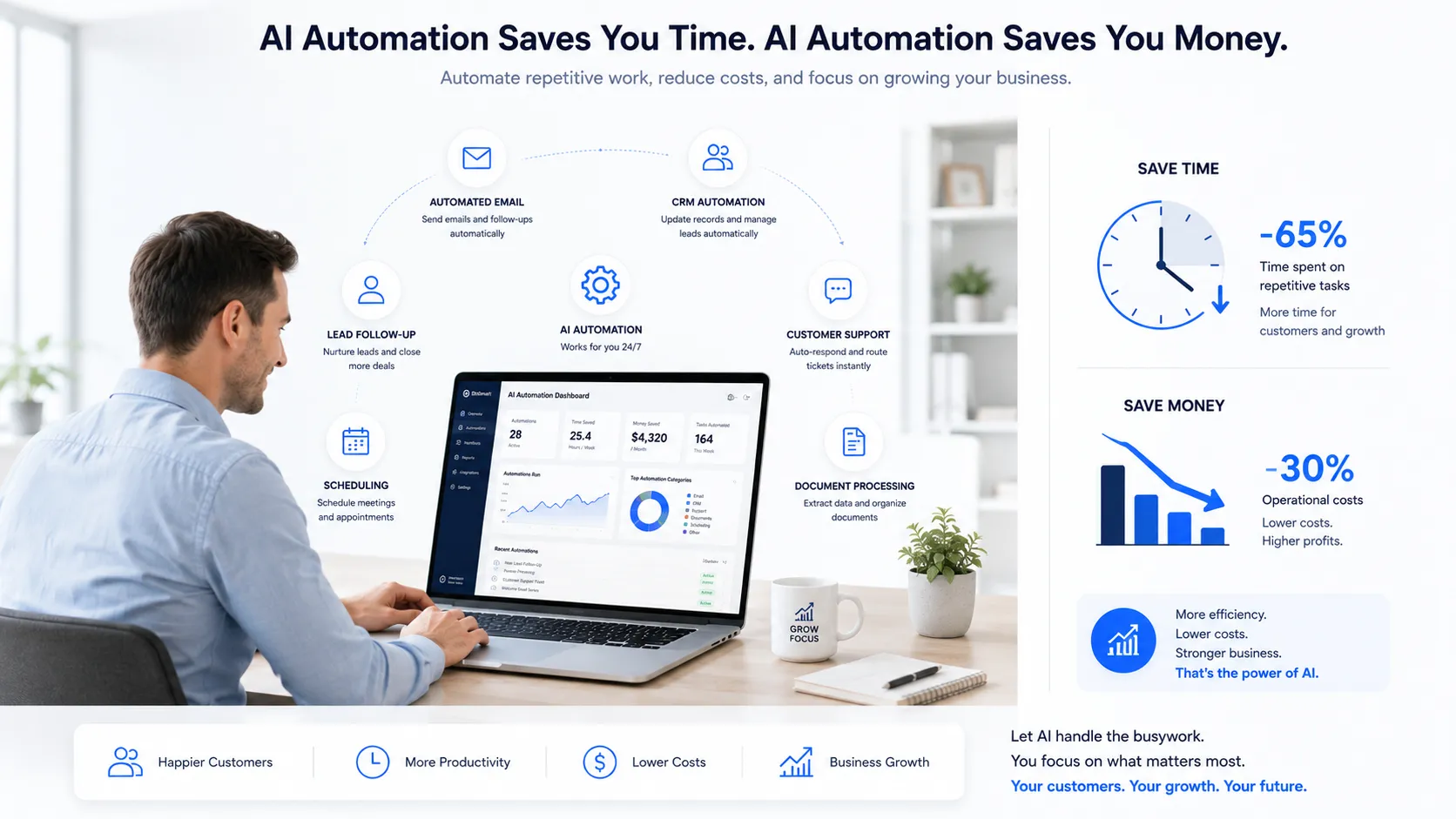
Saving time is only part of the equation.
When repetitive work becomes faster, businesses may be able to handle more customers without immediately increasing administrative headcount.
For example, consider a business where employees spend 20 hours each week on repetitive tasks.
If automation reduces that workload by 10 hours per week, the business gains approximately 520 hours of capacity per year.
That time can potentially be redirected toward:
- Sales
- Customer service
- Business development
- Higher-value projects
- Employee training
- Strategic planning
The goal should not simply be “reduce employees.”
A better goal is:
Get more productive work from the same team.
Recent research from the U.S. Chamber of Commerce Foundation similarly found that many small-business workers use AI to get more done, rather than to automate their jobs away.
12. Start With One Business Problem
One of the biggest mistakes small businesses can make is buying too many AI tools at once.
You don't need 20 AI applications.
Start with one repetitive problem.
Ask:
What task consumes the most employee time every week?
Then determine whether AI can reduce that workload.
For example:
| Business Problem | Potential AI Solution |
|---|---|
| Too many customer questions | AI chatbot |
| Slow lead follow-up | CRM automation |
| Too much email | AI email assistant |
| Manual data entry | Workflow automation |
| Content takes too long | AI content assistant |
| Meeting notes take too long | AI meeting assistant |
| Difficult reporting | AI data analysis |
| Appointment management | AI scheduling |
| Document processing | AI document extraction |
13. Don’t Automate Everything
AI works best when businesses use it strategically.
Some tasks should remain human-led.
These may include:
- Sensitive customer conversations
- Legal decisions
- Financial decisions
- Important negotiations
- High-value sales conversations
- Strategic business decisions
- Situations requiring professional judgment
AI should support employees rather than blindly make decisions that could create significant business risks.
The SBA also recommends considering risks and responsible implementation when using AI.
14. Protect Customer and Business Data
Before putting business information into an AI system, understand how that platform handles data.
Businesses should consider:
- What information is being uploaded?
- Is customer information involved?
- Who can access the data?
- How is the information stored?
- Does the AI provider use submitted information for training?
- What security controls are available?
- Are employees using unauthorized AI tools?
A simple AI policy can help employees understand what information they can and cannot enter into AI systems.
15. Measure the Results
AI implementation should be measured like any other business investment.
Before automating a task, determine how much time it currently takes.
For example:
Current process: 10 hours per week
After automation: 4 hours per week
Time saved: 6 hours per week
You can then estimate the annual value of those savings.
Also measure:
- Response time
- Number of leads handled
- Customer satisfaction
- Conversion rates
- Employee productivity
- Operating costs
- Revenue generated
If an AI tool doesn't create measurable value, reconsider whether you need it.
A Simple AI Strategy for a U.S. Small Business
Small businesses don't need to transform their entire company overnight.
A practical approach is:
Step 1: Identify repetitive work
Find tasks employees perform repeatedly every day or week.
Step 2: Calculate the cost
Estimate how much employee time the task consumes.
Step 3: Find an appropriate AI solution
Look for a tool or automation that addresses that specific problem.
Step 4: Start with a small test
Don't immediately automate a mission-critical process.
Test the workflow first.
Step 5: Keep humans involved
Have employees review AI outputs, especially during the early stages.
Step 6: Measure the results
Compare time, cost, quality, and productivity before and after implementation.
Step 7: Expand what works
Once one automation proves valuable, identify the next opportunity.
The Future of AI for Small Businesses
AI is becoming increasingly accessible to businesses of all sizes.
The U.S. Census Bureau reported that overall business AI usage remained around 17%–20% during its December 2025 to May 2026 measurement period, while usage was substantially higher among larger firms.
For smaller businesses, this creates both a challenge and an opportunity.
Businesses that learn how to use AI effectively can potentially operate more efficiently without needing the same resources as much larger competitors.
The competitive advantage isn't necessarily having the most AI tools.
It's knowing where AI can solve a real business problem.
Final Thoughts
AI doesn't have to be complicated or expensive for a small business.
A company can begin with something as simple as automating lead follow-ups, generating content, summarizing meetings, answering common customer questions, or processing documents.
The most effective strategy is to start small, measure the results, and gradually automate additional workflows.
For U.S. small businesses, the question is no longer simply whether AI is coming.
It's:
Where can AI save your business the most time, reduce unnecessary costs, and help your team focus on work that actually grows the company?
That is where AI automation can deliver real business value.


