
What Is SEO?
SEO (Search Engine Optimization) is the process of improving your website so it appears higher in search engine results like Google, Bing, and Yahoo when people search for products or services related to your business.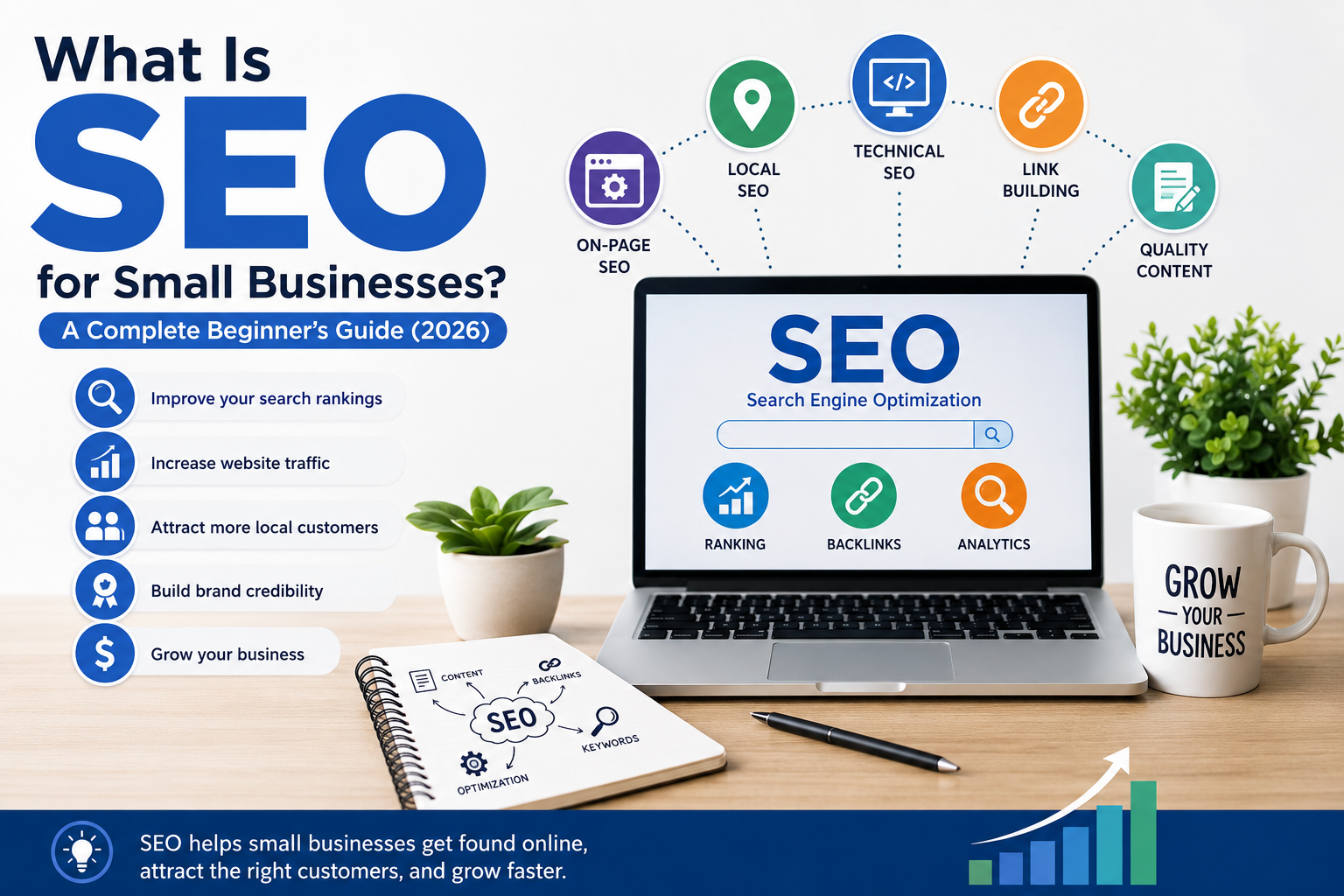
For example, if you own a bakery in New York, you want your website to appear when someone searches:
- Best bakery near me
- Fresh cakes in New York
- Birthday cake shop
- Custom cakes NYC
Instead of paying for every visitor through advertisements, SEO helps you attract organic (free) traffic from search engines.
Unlike paid advertising, SEO continues to deliver value long after your content is published. A well-optimized page can generate leads and customers for months or even years with regular updates and maintenance.
Search engines evaluate millions of web pages before deciding which ones deserve the top positions. Their goal is to provide users with the most helpful, trustworthy, and relevant content.
SEO helps your website meet those expectations.
What Is Small Business SEO?
Small Business SEO is the process of optimizing a small business website to rank higher in search engine results for relevant keywords that potential customers are searching for.
The goal isn't just to increase website traffic—it's to attract visitors who are genuinely interested in your products or services and are more likely to become customers.
Whether you own a:
- Local restaurant
- Dental clinic
- Plumbing business
- Law firm
- Real estate agency
- Marketing agency
- Online store
- Construction company
- Fitness center
SEO can help your business get discovered by people actively searching for your services.
Unlike large corporations with massive marketing budgets, small businesses often need to make every marketing dollar count. SEO offers a cost-effective way to compete by targeting the right audience at the right time.
Why SEO Matters for Small Businesses
Today, most buying journeys begin with an online search.
Before purchasing a product or hiring a service, people often search Google to compare businesses, read reviews, and gather information.
If your business isn't visible in search results, you're missing opportunities to connect with potential customers.
Here are some reasons why SEO is essential for small businesses.
1. Increase Website Traffic
Higher rankings lead to more clicks.
Research consistently shows that websites appearing on the first page of Google receive significantly more traffic than those on later pages. Improving your rankings increases the likelihood that people will visit your site.
More qualified visitors often translate into more inquiries, bookings, or sales.
2. Generate High-Quality Leads
Unlike traditional advertising, SEO targets users who are already looking for your products or services.
Someone searching for:
"Affordable SEO services for small businesses"
has a stronger intent than someone casually scrolling through social media.
This means SEO can deliver leads with higher conversion potential because you're meeting users at the moment they're looking for a solution.
3. Build Trust and Credibility
People naturally trust businesses that appear prominently in search results.
A well-designed website, useful content, positive customer reviews, and strong search visibility all contribute to building confidence in your brand.
SEO also encourages improvements in website quality, page speed, security, and user experience—all factors that influence customer trust.
4. Long-Term Marketing Investment
Paid ads stop generating traffic as soon as you stop spending.
SEO works differently.
While it takes time to build momentum, high-quality content and optimized pages can continue attracting visitors long after they're published.
This makes SEO one of the most sustainable digital marketing strategies available to small businesses.
5. Compete with Larger Businesses
Many small business owners assume they can't compete with national brands.
However, local SEO and targeted keyword strategies allow smaller businesses to compete effectively for searches in their specific geographic area or niche.
For example, instead of trying to rank for:
"SEO"
you might target:
- SEO services for small businesses
- Local SEO agency
- Affordable SEO services
- SEO company in Dallas
These more specific searches often have less competition and attract users with stronger buying intent.
Benefits of SEO for Small Businesses
Implementing an effective SEO strategy offers advantages beyond higher rankings.
Better Brand Awareness
When your website consistently appears in search results, more people become familiar with your business.
Even if they don't contact you immediately, repeated visibility helps build recognition and trust over time.
More Qualified Visitors
SEO attracts users based on what they're actively searching for.
Instead of marketing to a broad audience, you're connecting with people who already have an interest in your services.
This improves lead quality and increases the likelihood of conversions.
Improved User Experience
Modern SEO isn't just about keywords.
Google rewards websites that provide:
- Fast loading speeds
- Mobile-friendly design
- Easy navigation
- Helpful content
- Secure browsing (HTTPS)
Improving these areas benefits both your search rankings and your visitors.
Higher Return on Investment
Compared to many traditional marketing methods, SEO often delivers a stronger long-term return on investment.
While it requires consistent effort, the traffic generated through organic search doesn't require payment for every click.
Over time, this can reduce customer acquisition costs and improve overall marketing efficiency.
How Search Engines Work
To understand SEO, it's helpful to know how search engines find and rank websites.
Google generally follows three main steps.
1. Crawling
Google uses automated programs called crawlers (also known as spiders or bots) to discover pages across the internet.
These bots follow links from one page to another and collect information about new and updated content.
If your website is properly structured, search engines can easily discover your pages.
2. Indexing
After crawling a page, Google analyzes its content and stores it in a massive database known as the search index.
Only indexed pages are eligible to appear in search results.
If a page isn't indexed, users won't find it through Google search.
3. Ranking
When someone performs a search, Google's algorithm evaluates thousands of factors to determine which pages should appear first.
Some important ranking factors include:
- Content quality
- Search intent
- Keyword relevance
- Backlinks
- Website speed
- Mobile usability
- User experience
- Website authority
- Freshness of content
The pages that best satisfy the user's query are more likely to rank higher.
How Does SEO Work?
SEO is the process of helping search engines understand your website and making it valuable for users. When done correctly, Google is more likely to rank your pages higher for relevant searches.
Think of SEO as building a strong reputation online. The more useful, trustworthy, and user-friendly your website is, the better your chances of appearing on the first page of search results.
The SEO process generally includes these steps:
1. Keyword Research
Every SEO campaign begins with identifying the words and phrases your potential customers search for.
For example, if you offer SEO services, relevant keywords might include:
- SEO for small businesses
- Affordable SEO services
- Local SEO company
- SEO agency near me
- Technical SEO services
Choosing the right keywords helps ensure your content reaches people actively looking for your services.
2. Creating High-Quality Content
Once you've identified your target keywords, create content that genuinely answers users' questions.
Google prioritizes content that is:
- Helpful
- Accurate
- Easy to understand
- Well-structured
- Up to date
Avoid stuffing keywords into every paragraph. Instead, write naturally while covering the topic thoroughly.
3. Optimizing Your Website
SEO also involves improving your website so search engines can easily understand it.
This includes optimizing:
- Page titles
- Meta descriptions
- Heading tags
- Images
- Internal links
- URL structure
- Mobile responsiveness
- Website speed
These improvements help both users and search engines navigate your site more effectively.
4. Building Authority
Google considers websites with strong reputations more trustworthy.
One way to build authority is by earning backlinks—links from other reputable websites pointing to your content.
Quality matters far more than quantity. A few links from trusted websites are generally more valuable than many links from low-quality sources.
5. Monitoring and Improving
SEO isn't a one-time task.
Search trends, competitors, and Google's algorithms change regularly.
Successful businesses continually:
- Update existing content
- Publish new articles
- Improve website performance
- Monitor rankings
- Analyze traffic
- Fix technical issues
Continuous improvement helps maintain and grow search visibility.
Types of SEO
SEO isn't just one activity. It consists of several important areas working together.
1. On-Page SEO
On-page SEO refers to everything you optimize directly on your website.
Examples include:
- Writing keyword-rich titles
- Creating valuable content
- Optimizing headings
- Adding internal links
- Improving image alt text
- Creating descriptive URLs
- Using schema markup where appropriate
Good on-page SEO helps search engines understand what each page is about.
2. Off-Page SEO
Off-page SEO focuses on building your website's reputation across the internet.
Common activities include:
- Earning backlinks
- Guest blogging
- Digital PR
- Brand mentions
- Social sharing
- Online partnerships
These signals indicate that other websites trust your content.
3. Technical SEO
Technical SEO improves the behind-the-scenes aspects of your website.
Examples include:
- Fast loading speeds
- Mobile-friendly design
- HTTPS security
- XML sitemap
- Robots.txt optimization
- Fixing crawl errors
- Structured data (Schema)
- Core Web Vitals optimization
Technical SEO helps search engines crawl and index your website efficiently.
4. Local SEO
For businesses serving specific locations, Local SEO is extremely important.
Local SEO helps your business appear in searches like:
- Dentist near me
- Best restaurant in Chicago
- SEO agency in Dallas
- Electrician near me
Important Local SEO factors include:
- Google Business Profile
- Customer reviews
- Local citations
- Location pages
- NAP consistency (Name, Address, Phone Number)
Local SEO can significantly increase phone calls, website visits, and foot traffic.
Understanding Search Intent
One of the biggest SEO mistakes beginners make is focusing only on keywords instead of search intent.
Search intent is the reason behind a user's search.
Google wants to provide results that match what users actually want.
There are four main types of search intent.
1. Informational Intent
The user wants to learn something.
Examples:
- What is SEO?
- How does SEO work?
- SEO checklist
These users are looking for educational content.
2. Navigational Intent
The user wants to visit a specific website.
Examples:
- Facebook login
- YouTube
- Google Search Console
They already know where they want to go.
3. Commercial Investigation
The user is comparing options before making a decision.
Examples:
- Best SEO companies
- SEO pricing
- Top local SEO agencies
- SEO software comparison
These users are close to purchasing but still researching.
4. Transactional Intent
The user is ready to take action.
Examples:
- Hire SEO expert
- Buy SEO services
- Affordable SEO company
These searches often have the highest conversion potential because the user is prepared to make a purchase or contact a business.
Basic Keyword Research for Beginners
Keyword research is the foundation of every successful SEO strategy.
Instead of guessing what people search for, use research tools to find relevant keywords.
Some popular tools include:
- Google Keyword Planner
- Google Search Console
- Ahrefs
- SEMrush
- Ubersuggest
- Moz Keyword Explorer
When selecting keywords, consider:
- Search volume
- Keyword difficulty
- User intent
- Relevance to your business
- Potential for conversions
Example
Suppose you own a digital marketing agency.
Instead of targeting a broad keyword like:
SEO
You could focus on more specific phrases such as:
- SEO for small businesses
- Affordable SEO services
- Local SEO services
- SEO consultant for startups
- SEO company for small businesses
These long-tail keywords often have lower competition and attract visitors who know exactly what they're looking for.
Complete On-Page SEO Checklist
On-page SEO refers to optimizing the elements on your website that both users and search engines can see. Strong on-page SEO helps search engines understand your content while improving the overall user experience.
Here are the key elements every small business website should optimize.
1. Optimize Your Page Title
The page title is one of the first things users see in Google search results. It should clearly describe the page and include your primary keyword naturally.
Example:
SEO for Small Businesses: A Complete Beginner's Guide (2026)
Best Practices:
- Keep it between 50–60 characters.
- Include your main keyword near the beginning.
- Make it compelling enough to encourage clicks.
- Avoid duplicate titles across your website.
2. Write an Engaging Meta Description
Although meta descriptions don't directly improve rankings, they can increase your click-through rate.
A good meta description should:
- Summarize the page.
- Include the primary keyword naturally.
- Encourage users to click.
Aim for around 150–160 characters.
3. Use Proper Heading Structure
Headings make your content easier to read and help search engines understand the page hierarchy.
A good structure looks like this:
- H1 – Main Page Title
- H2 – Main Sections
- H3 – Subsections
- H4 – Additional details (when necessary)
Avoid using multiple H1 tags on a single page.
4. Create SEO-Friendly URLs
Keep URLs short, descriptive, and easy to read.
Good Example
yourwebsite.com/seo-for-small-businesses
Avoid
yourwebsite.com/post?id=45892&cat=seo
Short URLs are easier for both users and search engines to understand.
5. Optimize Images
Images improve user experience, but they should also be optimized.
Best practices include:
- Compress images for faster loading.
- Use descriptive filenames.
- Add meaningful ALT text.
- Use modern image formats like WebP where possible.
Example ALT text:
"Small business owner analyzing SEO performance dashboard."
6. Internal Linking
Internal links connect related pages on your website.
For example, this article can link to:
- SEO Services
- Local SEO Services
- Technical SEO Guide
- Google Ads Services
- Website Development
Benefits include:
- Better website navigation
- Improved crawling by search engines
- More page authority distributed throughout your website
- Increased time spent on your website
Technical SEO Basics
Technical SEO ensures search engines can crawl, understand, and index your website efficiently.
Even great content may struggle to rank if technical issues prevent Google from accessing your pages.
Website Speed
Users expect fast-loading websites.
A slow website often results in:
- Higher bounce rates
- Lower conversions
- Poor user experience
- Reduced search rankings
Ways to improve speed:
- Compress images
- Enable browser caching
- Minify CSS and JavaScript
- Use a Content Delivery Network (CDN)
- Choose reliable hosting
Mobile-Friendly Design
More than half of web traffic comes from mobile devices.
Your website should:
- Display correctly on all screen sizes.
- Have readable text.
- Use buttons that are easy to tap.
- Load quickly on mobile networks.
Google primarily evaluates the mobile version of websites when determining rankings.
HTTPS Security
Every business website should use HTTPS.
Benefits include:
- Secure customer data
- Increased trust
- Better SEO
- Browser security indicators
Visitors are more likely to trust secure websites.
XML Sitemap
An XML sitemap helps search engines discover your important pages.
It acts like a roadmap for your website and makes it easier for Google to crawl new or updated content.
Robots.txt
This file tells search engines which pages they can and cannot crawl.
Proper configuration prevents indexing of unnecessary pages while allowing important content to be discovered.
Local SEO Strategies for Small Businesses
If your business serves a specific city or region, Local SEO should be a major focus.
Here are the most effective strategies.
Optimize Your Google Business Profile
A complete and accurate Google Business Profile can significantly improve local visibility.
Make sure your profile includes:
- Business name
- Address
- Phone number
- Website
- Business hours
- Services
- Photos
- Customer reviews
Keep this information updated at all times.
Collect Customer Reviews
Positive reviews help build trust and influence both rankings and customer decisions.
Encourage satisfied customers to leave honest reviews after completing a purchase or service.
Always respond professionally to both positive and negative feedback.
Maintain Consistent Business Information
Your business name, address, and phone number (NAP) should remain consistent across:
- Your website
- Google Business Profile
- Business directories
- Social media platforms
Consistency helps search engines verify your business information.
Create Location-Specific Pages
If you serve multiple cities, create dedicated pages for each location.
Examples:
- SEO Services in Dallas
- SEO Services in Houston
- SEO Services in Austin
Each page should provide unique content rather than duplicating information.
Content Marketing and SEO
Content is the foundation of successful SEO.
Google rewards websites that consistently publish valuable, original, and relevant information.
Examples of content include:
- Blog posts
- Case studies
- How-to guides
- FAQs
- Videos
- Infographics
- Industry insights
Rather than publishing random articles, organize your content around topic clusters.
For example:
Pillar Page
SEO for Small Businesses
Supporting articles:
- Local SEO Guide
- Keyword Research Guide
- Technical SEO Basics
- SEO Pricing Guide
- On-Page SEO Checklist
- Google Business Profile Guide
This structure helps establish topical authority and makes it easier for search engines to understand your expertise.
Link Building for Beginners
Backlinks remain an important ranking factor because they act as endorsements from other websites.
However, quality matters much more than quantity.
Some ethical ways to earn backlinks include:
- Publishing helpful guides
- Writing guest articles
- Creating original research
- Sharing case studies
- Building free tools or templates
- Networking with industry websites
Avoid purchasing backlinks or participating in link schemes, as these practices violate search engine guidelines and can lead to ranking penalties.
Common SEO Mistakes Small Businesses Should Avoid
Many small businesses invest time and money into SEO but fail to see results because of avoidable mistakes. Understanding these common pitfalls can save you time and help improve your rankings.
1. Targeting the Wrong Keywords
Many businesses focus only on high-volume keywords without considering competition or user intent.
For example, trying to rank for "SEO" is extremely difficult because large, established websites dominate this keyword.
Instead, target more specific, long-tail keywords such as:
- SEO for small businesses
- Affordable SEO services
- Local SEO company
- SEO consultant for startups
These keywords typically have lower competition and attract users who are closer to making a decision.
2. Publishing Thin or Duplicate Content
Google values original, helpful, and in-depth content.
Avoid:
- Copying content from other websites.
- Publishing very short articles that don't answer the user's question.
- Creating multiple pages targeting the same keyword without adding unique value.
Focus on producing comprehensive content that genuinely helps your audience.
3. Ignoring Mobile Users
Since Google primarily uses the mobile version of your website for indexing, a poor mobile experience can hurt your rankings.
Ensure that your website:
- Loads quickly on smartphones.
- Uses readable fonts.
- Has easy-to-click buttons.
- Displays content correctly on all screen sizes.
A responsive design is essential for both SEO and user satisfaction.
4. Forgetting Internal Links
Many businesses publish blog posts without linking them to related pages.
Internal links help:
- Search engines understand your website structure.
- Users discover more helpful content.
- Distribute page authority across your website.
For example, if you publish an article about keyword research, link it to your SEO for Small Businesses service page and other related blogs.
5. Expecting Immediate Results
SEO is a long-term investment.
While some improvements may appear within a few weeks, meaningful growth often takes 3–6 months, and competitive industries may require even more time.
Consistency is the key to long-term success.
How to Measure SEO Success
Once you've started optimizing your website, it's important to monitor your progress.
Here are the key metrics to track.
Organic Traffic
Organic traffic refers to visitors who find your website through unpaid search results.
An increase in organic traffic generally indicates that your SEO efforts are working.
Keyword Rankings
Track the position of your target keywords over time.
Examples include:
- SEO for small businesses
- Local SEO services
- Affordable SEO company
Higher rankings often lead to increased visibility and more qualified visitors.
Click-Through Rate (CTR)
CTR measures how often users click your website after seeing it in search results.
You can improve CTR by:
- Writing compelling page titles.
- Creating engaging meta descriptions.
- Matching user intent.
Conversion Rate
Traffic alone doesn't grow a business.
Measure how many visitors:
- Submit a contact form.
- Request a quote.
- Call your business.
- Purchase a product.
- Book a consultation.
Improving conversions is just as important as increasing traffic.
Bounce Rate and Engagement
If visitors leave your website immediately, it may indicate:
- Poor user experience.
- Slow loading pages.
- Irrelevant content.
- Difficult navigation.
Creating engaging, easy-to-read content encourages users to stay longer and explore additional pages.
Essential SEO Tools for Beginners
You don't need expensive software to get started with SEO. Several reliable tools can help you analyze performance, identify opportunities, and improve your website.
Here are some popular options:
- Google Search Console – Monitor indexing, search performance, and technical issues.
- Google Analytics 4 (GA4) – Track website traffic, user behavior, and conversions.
- Google Keyword Planner – Discover keyword ideas and search volume.
- Google PageSpeed Insights – Analyze page speed and Core Web Vitals.
- Ahrefs – Research backlinks, keywords, and competitors.
- SEMrush – Perform keyword research, site audits, and competitive analysis.
- Ubersuggest – Explore keyword ideas and basic SEO insights.
- Screaming Frog SEO Spider – Audit your website for technical SEO issues.
Start with the free Google tools, then consider premium platforms as your business grows.
Frequently Asked Questions (FAQs)
Is SEO worth it for small businesses?
Yes. SEO helps small businesses attract targeted traffic, generate qualified leads, and build long-term visibility without paying for every click.
How long does SEO take?
Most businesses begin to notice improvements within 3–6 months, although results depend on competition, website quality, and consistency.
Can I do SEO myself?
Yes. Many basic SEO tasks—such as keyword research, writing quality content, improving page titles, and optimizing images—can be learned and implemented by business owners. However, more advanced strategies like technical SEO and large-scale link building may require professional expertise.
Is Local SEO different from traditional SEO?
Yes. Local SEO focuses on helping businesses appear in location-based searches, such as "plumber near me" or "SEO agency in Dallas." It emphasizes optimizing your Google Business Profile, managing reviews, and maintaining consistent business information across the web.
Should I choose SEO or Google Ads?
The two strategies work best together. Google Ads can generate immediate traffic, while SEO builds sustainable, long-term organic visibility. If your budget allows, combining both often delivers the strongest overall marketing results.
Final Thoughts
SEO is no longer optional for small businesses that want to grow online. Whether you run a local service company, an eCommerce store, or a digital agency, your customers are searching for solutions every day—and appearing in those search results can make a significant difference.
Success with SEO doesn't come from shortcuts or quick fixes. It comes from consistently publishing valuable content, optimizing your website, improving user experience, and earning trust over time.
Start by understanding your audience, researching the right keywords, creating helpful content, and monitoring your performance. As your website grows, continue updating older pages, building quality backlinks, and refining your strategy based on data.
Remember, SEO is a long-term investment that compounds over time. The effort you put in today can continue generating traffic, leads, and customers for years to come.
Ready to Improve Your Small Business SEO?
If you're looking to increase your online visibility, attract more qualified leads, and grow your business through search engines, a well-planned SEO strategy can help you achieve your goals.
At Jaseir Technologies, we provide tailored SEO solutions designed specifically for small businesses. From technical SEO and keyword research to content optimization and local SEO, our team focuses on strategies that deliver measurable, long-term results.
Get in touch with us today to discover how professional SEO can help your small business grow in 2026 and beyond.


